
The farmhouse recipe at a glance
Three real builds, sixteen steps, zero invented mechanics: what follows is exactly what the videos show, and every claim that goes beyond the screen is sourced in the FAQ.
- Farmhouse is a style, not a preset — Paralives has no farm lot type.
- The bones are ordinary: two-story box, grey gable, dormer, wraparound porch.
- Field rows are planter boxes over painted dirt — crops arrive with the planned gardening update, not before.
- The Countryside cows are decorative lot statues: free charm, zero upkeep.
- Two silhouettes plus a shortcut — laney's tall blue two-story, Mya Cove's low white multi-gable, Mosslight Nook's one-story.
- Every step deep-links to the exact second of its source speedbuild.
Shell & porch
Raise the farmhouse shell
Every farmhouse here starts as an ordinary two-story box — nothing in Paralives is farm-specific at this stage. laney's Family Farmhouse speedbuild shows how little the bones ask of you: four walls, a gable, a deck. The character arrives later, in paint, posts and pickets.
- 1
Drag the first wall run on an empty field
laney starts on bare grass with the wall tool: one long street-side run, an L-return for the porch bay, and a floor patch inside. Nothing here is farm-specific — the shell is an ordinary box that will earn its character from paint, porch and yard.
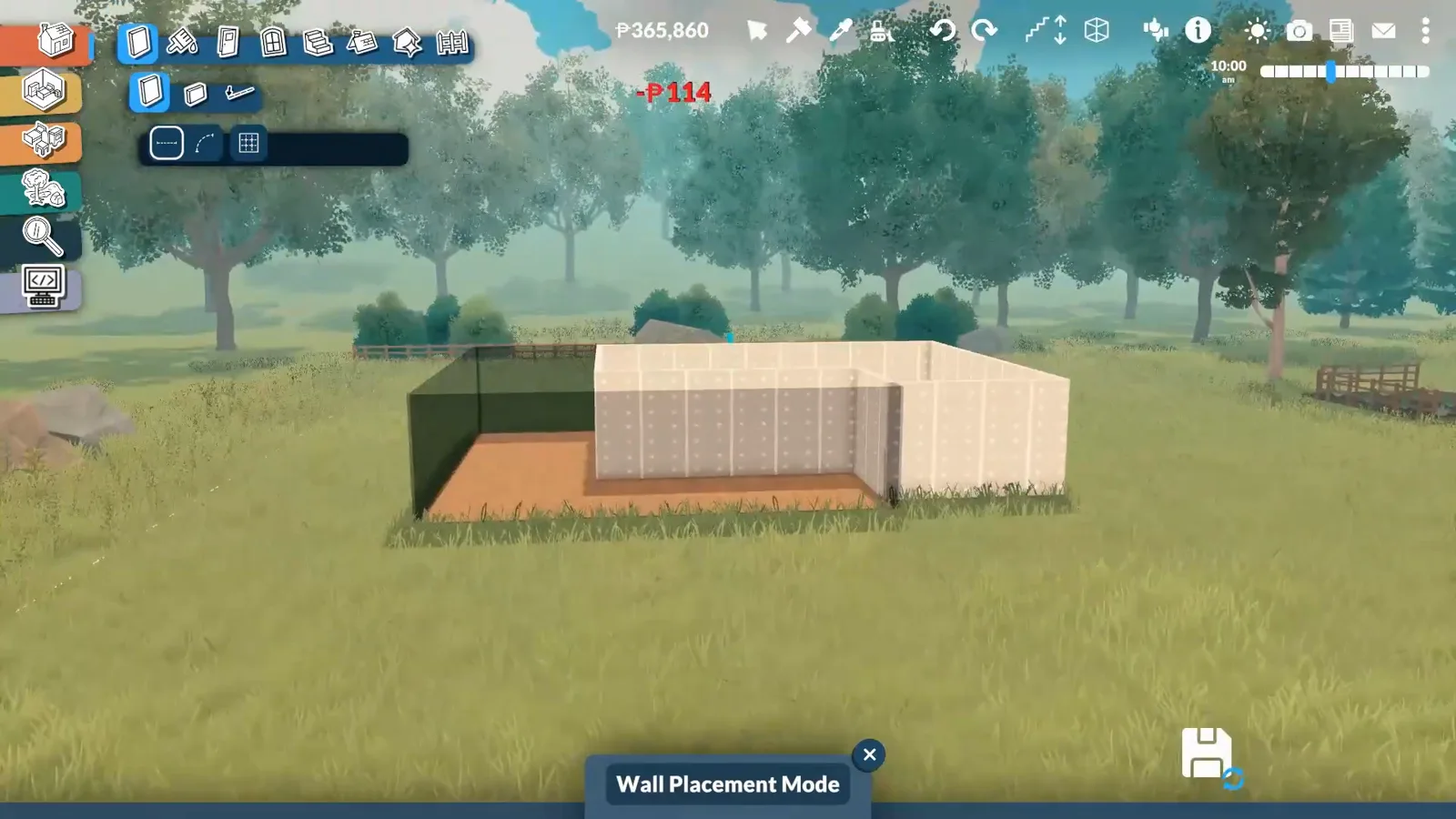
laney opens on bare grass — the shell is an ordinary box until paint and porch arrive.Watch at 0:50 - 2
Cap it with a grey gable and a front dormer
The roof goes on while the walls are still cream: a main gable over the deep body, a street-facing dormer over the door bay, and a colour swap that turns the brick-red swatch grey on the fly. This silhouette — steep roof, small dormer — is what reads farmhouse from the road.
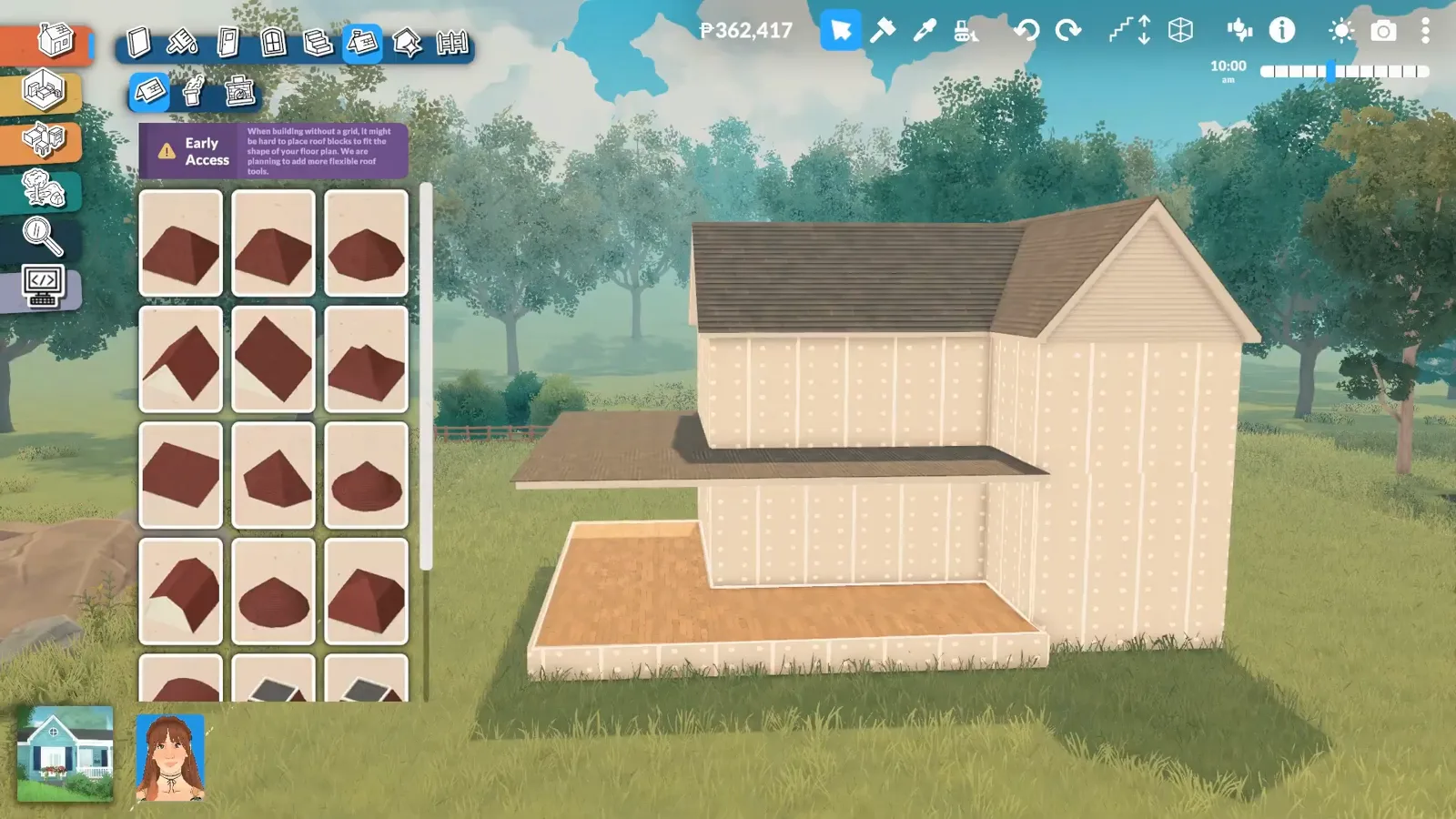
Grey shingles and a dormer fix the silhouette before the paint ever goes on.Watch at 2:12 - 3
Bring the porch across the front
Fresh blue siding and a raised deck wrap the walls from the front door around the side — the wraparound porch that every farmhouse needs. It will become the outdoor living room later, so it is worth overbuilding now: deeper is better, corners included.
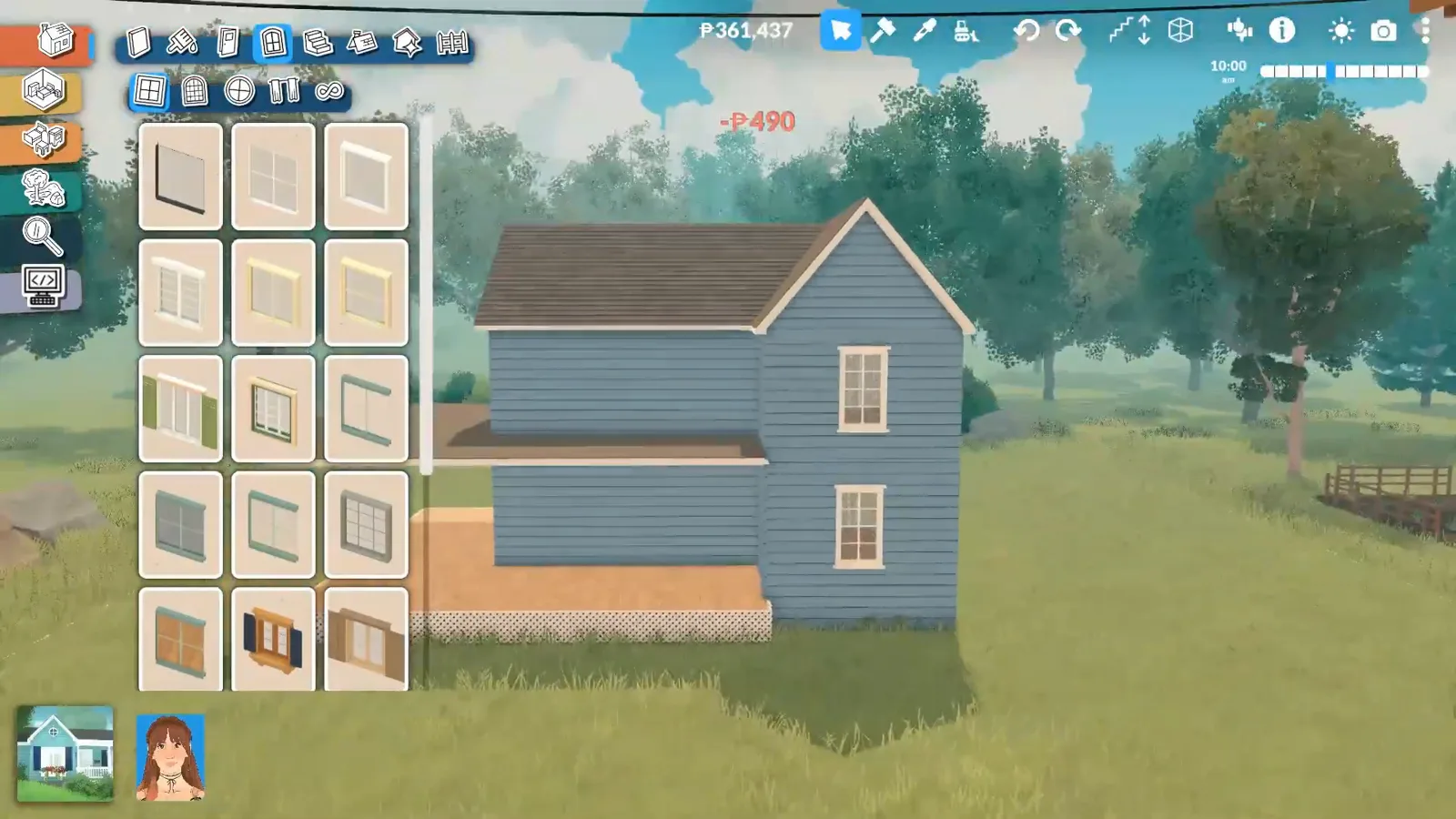
Blue paint plus a wraparound deck: the farmhouse read arrives early.Watch at 3:10 - 4
Place and square every porch post
Posts are individual catalogue pieces, not an auto-railing: laney sets each one along the deck edge and squares it up with the placement gizmo before moving to the next. Slow, but it is why the porch later holds hanging plants, rockers and a swing without looking crowded.
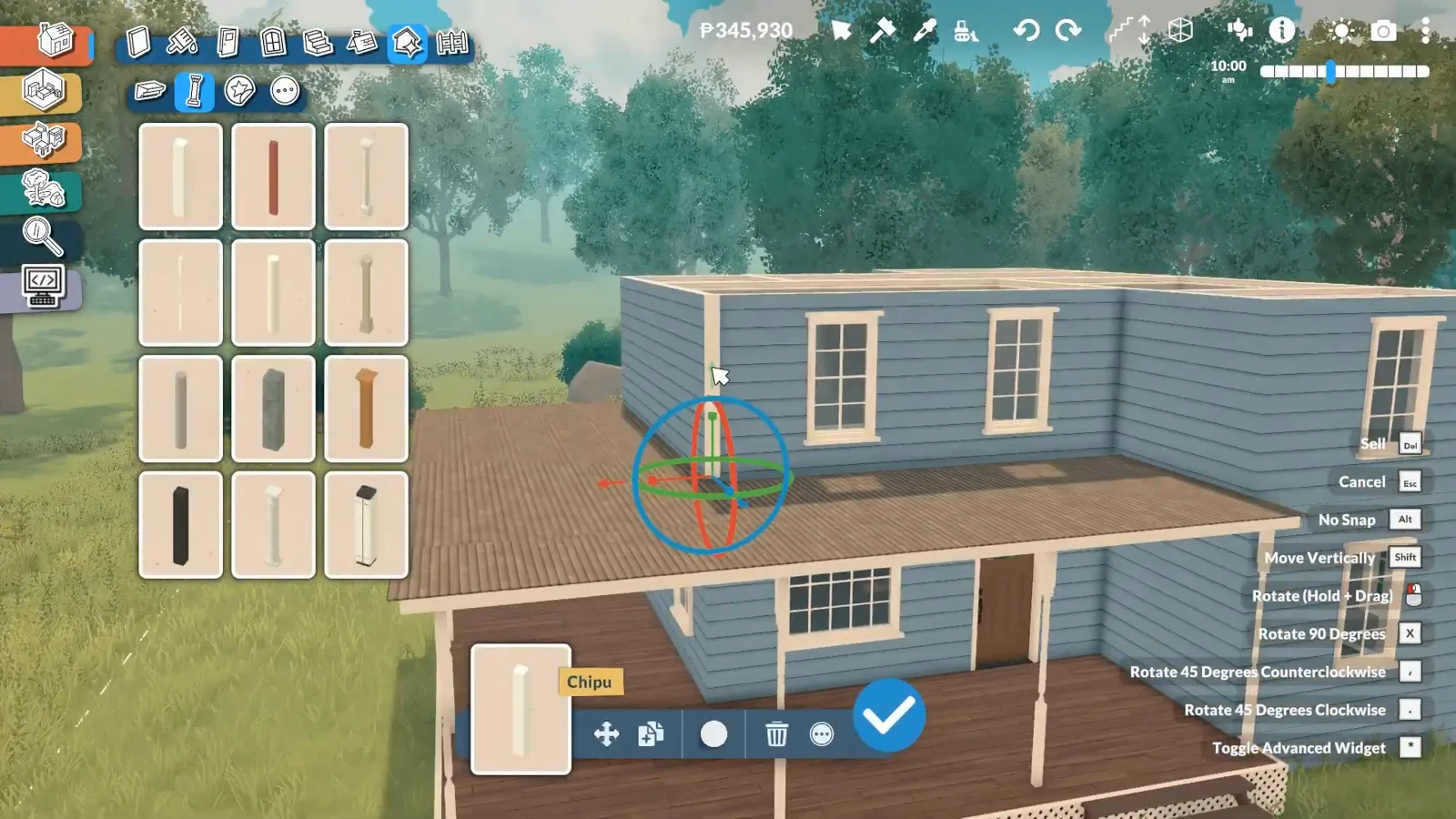
No auto-porch here — every post is placed and squared by hand.Watch at 10:16
Fences & fields
Lay out the working farmyard
The farm half of a farmhouse is theatre, and Paralives hands you every prop: picket runs, a garden arch, planter boxes and paintable dirt. There is no farming skill to feed because the game does not have one yet — the yard simply has to look like it feeds the house.
- 5
Fence the yard in white picket
The picket fence is a structure piece that drags into long runs and corners. laney closes a garden room against the house wall and leaves a gap for stepping stones — while the lot's plastic cows hold their post along the fence line, exactly where the decoration belongs.
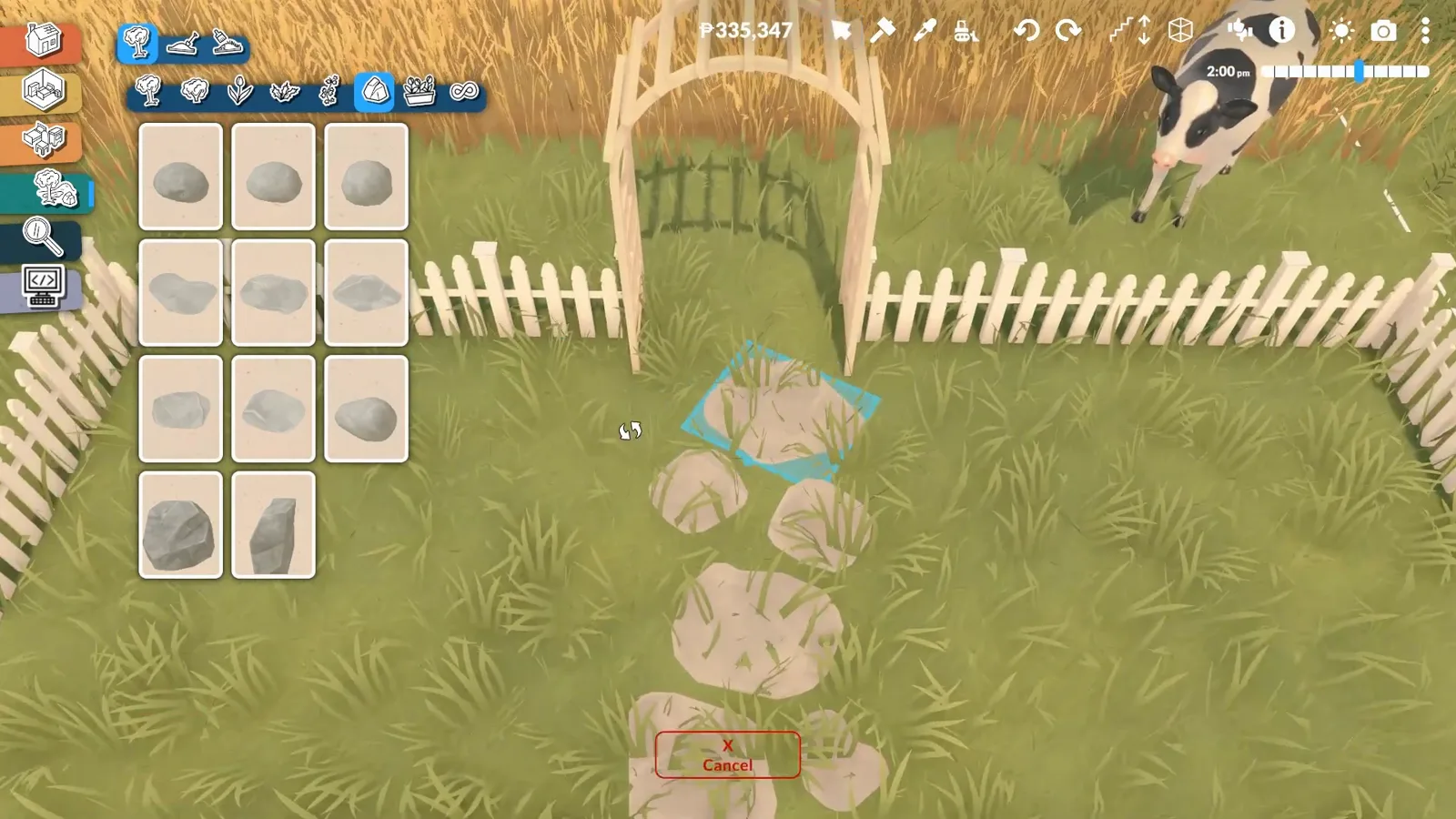
Picket, stones, and the lot's plastic cows on fence patrol.Watch at 24:22 - 6
Frame the path with a garden arch and a planter
A white garden arch stands over the stone path where it leaves the porch, with a raised planter tucked beside it. Both are ordinary décor pieces, and together they are the cheapest working-farm signal in the entire build.
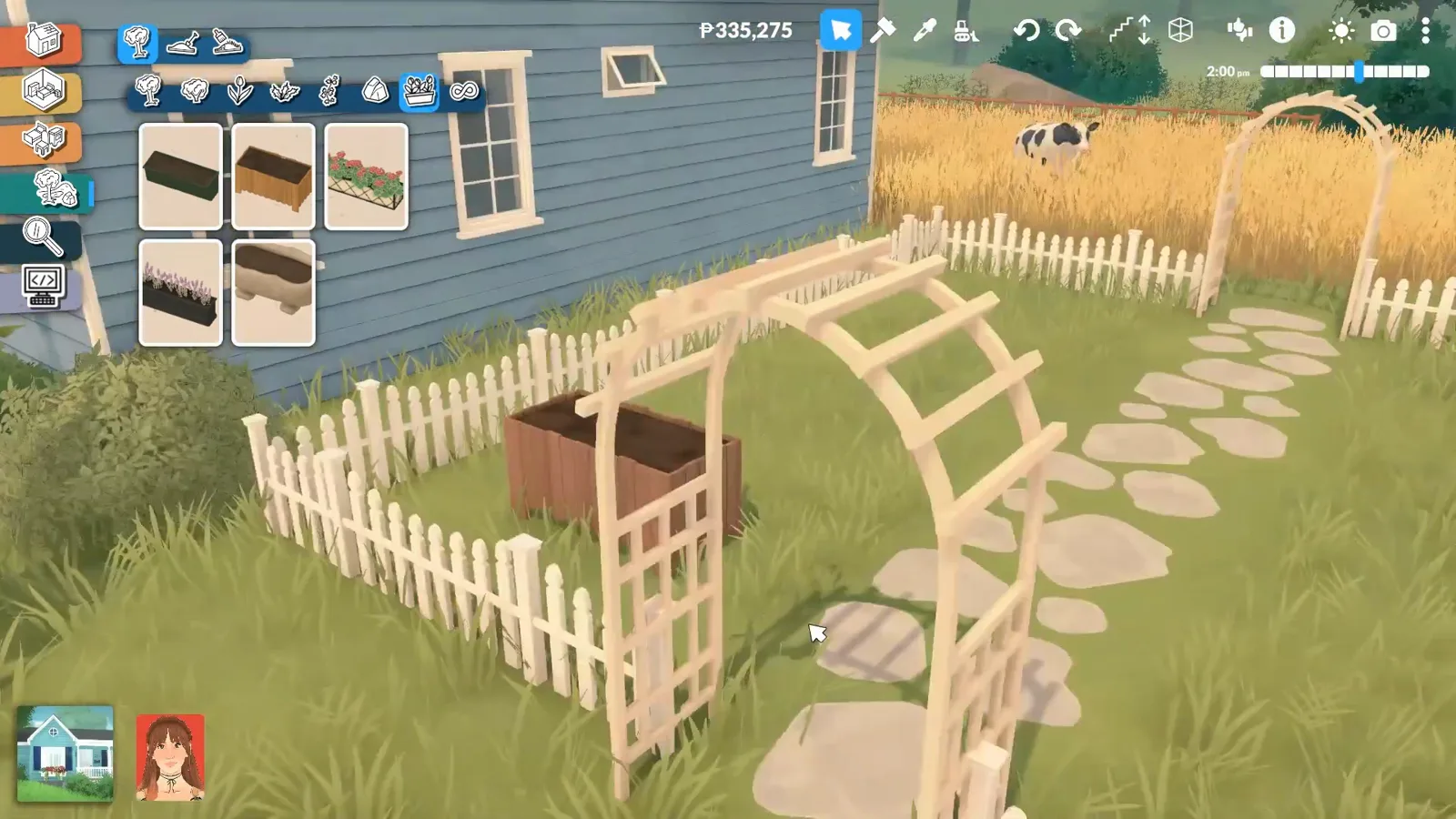
Arch, planter, stones: three pieces that quietly say farm.Watch at 24:47 - 7
Paint the field rows with terrain and planters
There is no crop mechanic in the game yet — gardening is a planned post-Early-Access system — so the field is set dressing: dark planter boxes in two ranks along a bare-earth strip painted with the terrain tool. From the road, it reads as a working kitchen garden.
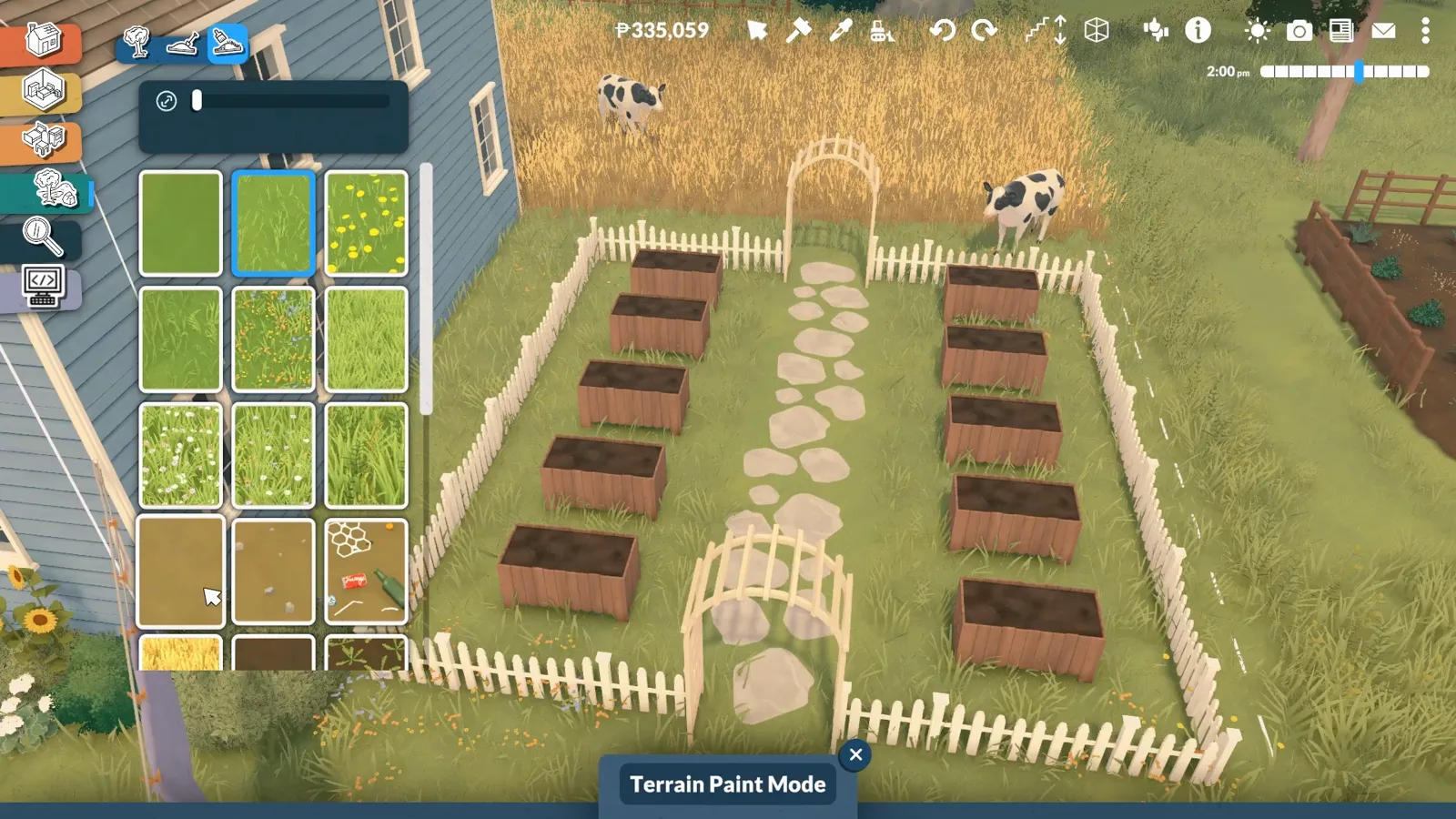
Planter boxes over painted dirt — the crops are décor until the gardening update ships.Watch at 26:02
Wallpaper & wood
Furnish the farmhouse inside
laney dresses the whole plan in one register: wood wainscot, floral wallpaper and furniture that looks inherited rather than bought. The nursery, the kitchen's hood-and-shelves trio and the sitting room below are all standard catalogue pieces — the farmhouse mood is paint and pattern, not themed objects.
- 8
Tuck a crib into the smallest back room
The nursery crib drops into the little room over the porch, and the color swatches settle its bedding on a farm-neutral cream. Wood panel walls carry the theme, so the room needs no novelty furniture to belong.
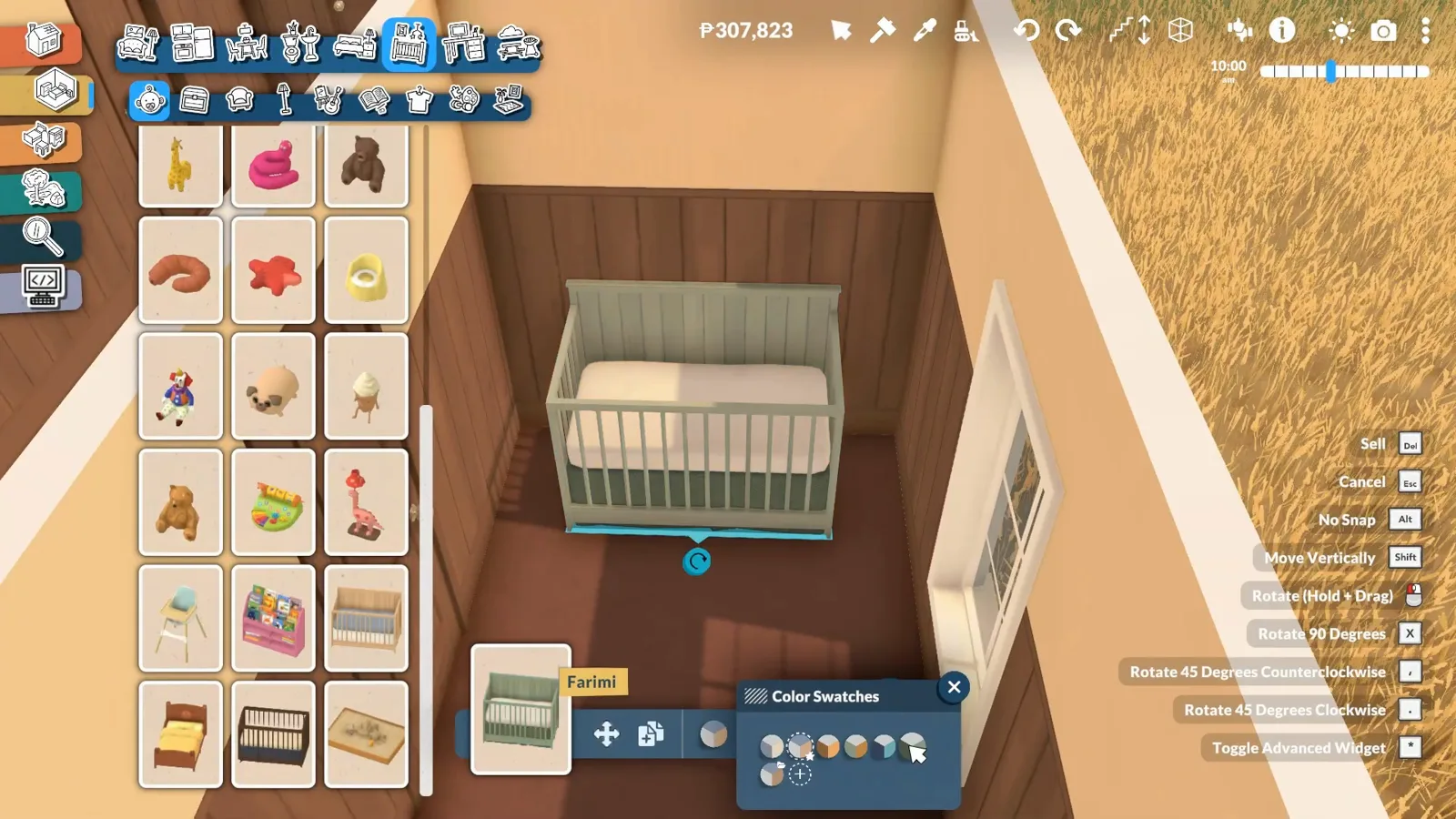
A crib and cream bedding carry the nursery; wood wainscot does the theming.Watch at 59:10 - 9
Dress the kitchen with a hood and open shelves
Three pieces make this kitchen read farmhouse: the tan range hood over the stove, open shelves stacked with dishes and a kettle, and the cream vintage fridge at the end of the run. None of them is themed — they are just the right silhouettes in the right materials.
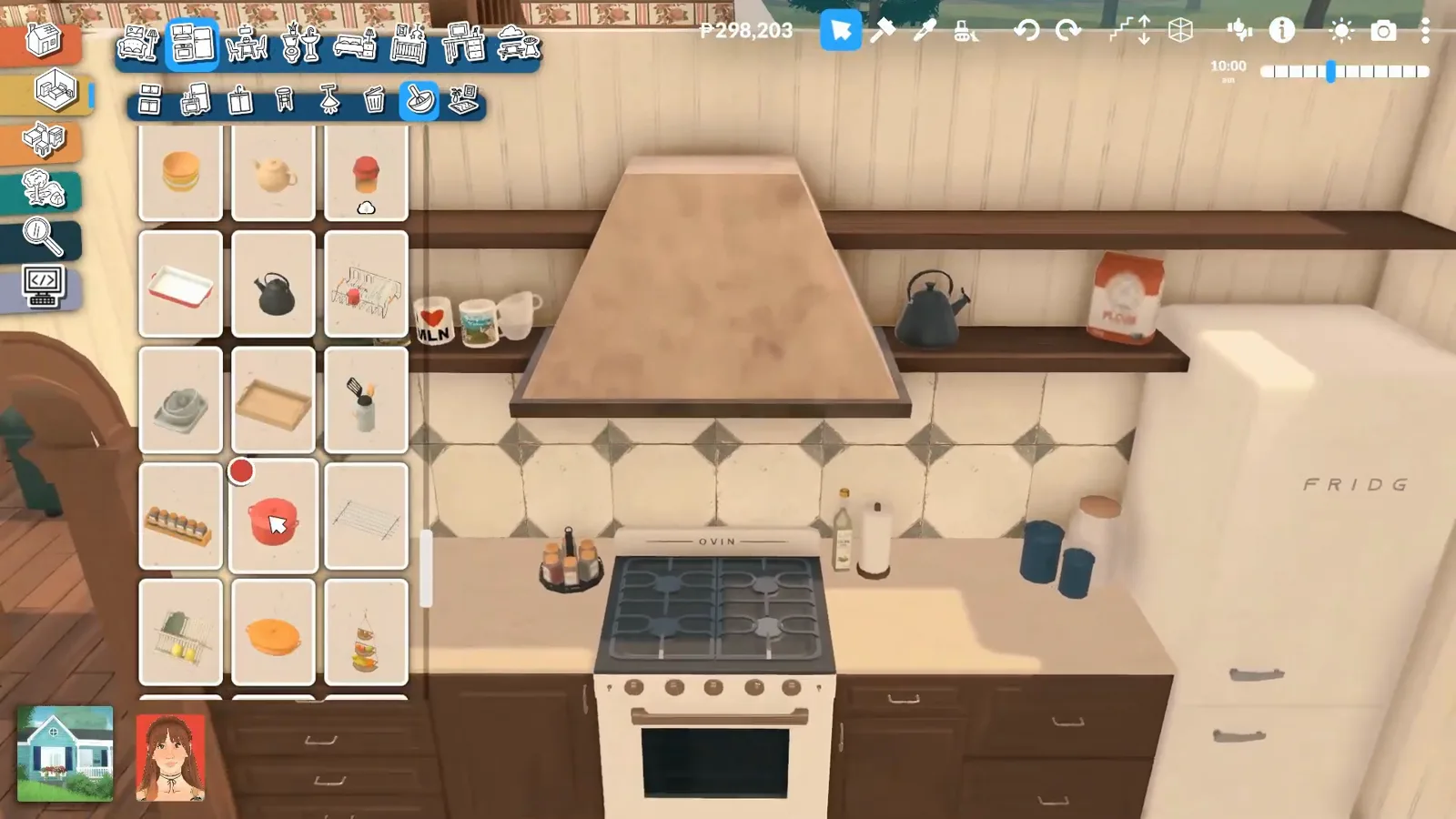
Hood, shelves, vintage fridge — the farmhouse kitchen trio.Watch at 72:46 - 10
Hang floral wallpaper in the sitting room
The wallpaper panel's small floral print does more farmhouse work than any themed object: laney runs it above the wood wainscot line, then lets a tufted green sofa and framed art finish the room. One pattern, repeated, is the whole trick.
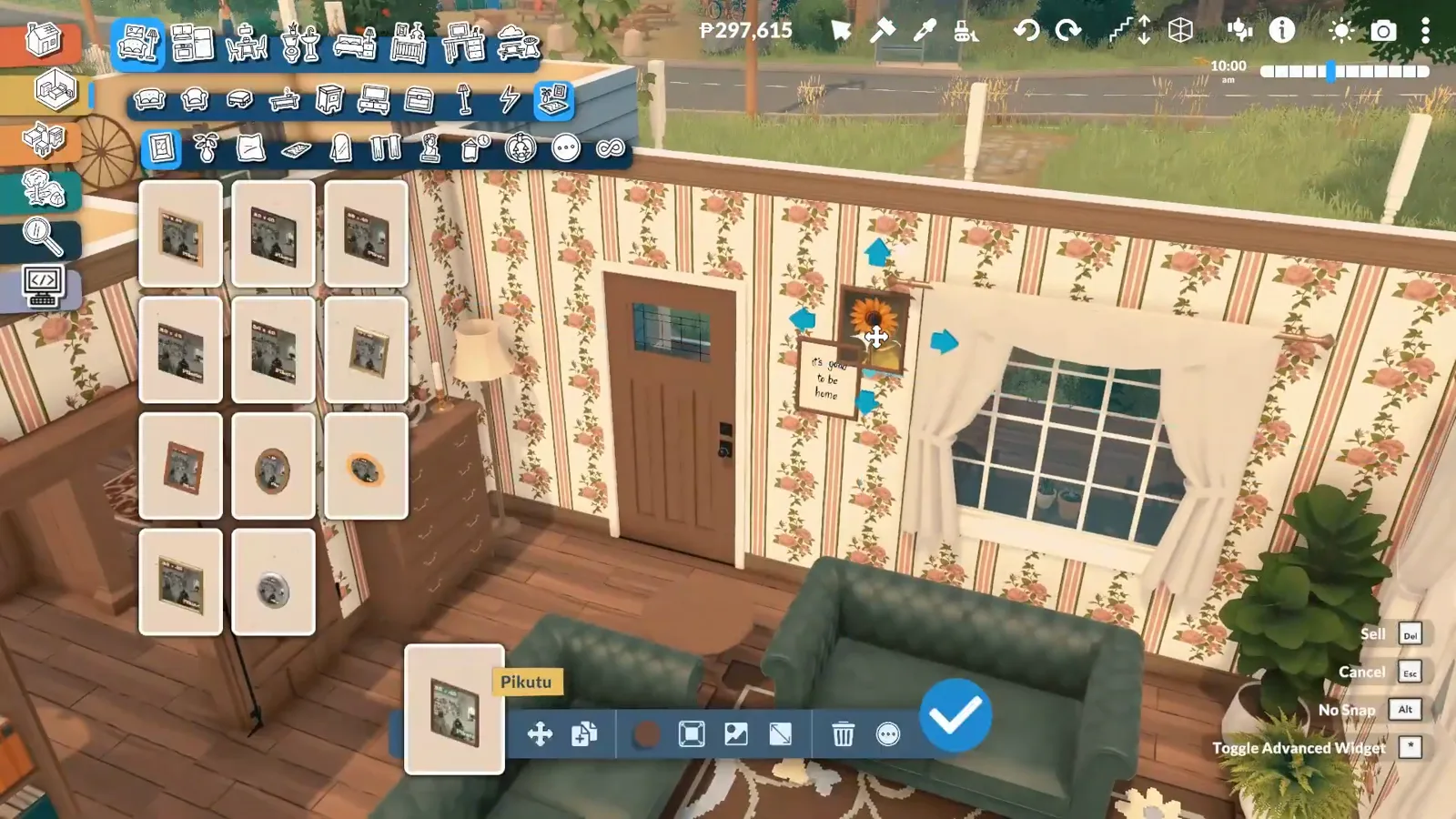
The wallpaper is the theme; the sofa just has to agree with it.Watch at 75:47 - 11
Lift the roof and check the whole plan
Before any final tour, the cutaway view shows the furnished plan at a glance — stairs, bedrooms, bath, and the field rows waiting outside the wall. It is the moment to catch rooms that ended up too thin for their furniture, while fixing them is still cheap.
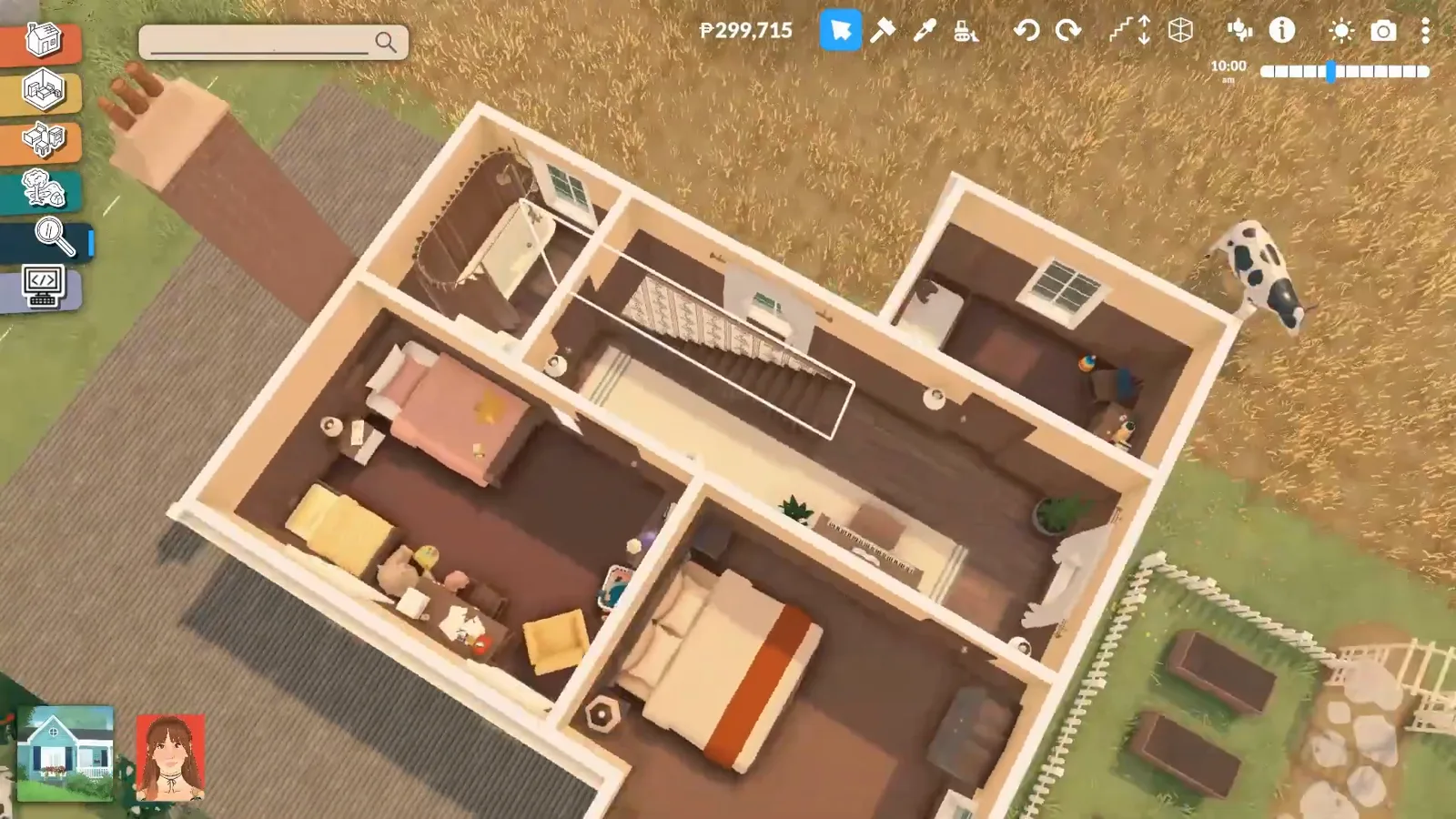
The whole plan at a glance — beds, bath, stairs, and the field beyond the wall.Watch at 67:13
Second take
The golden-field farmhouse
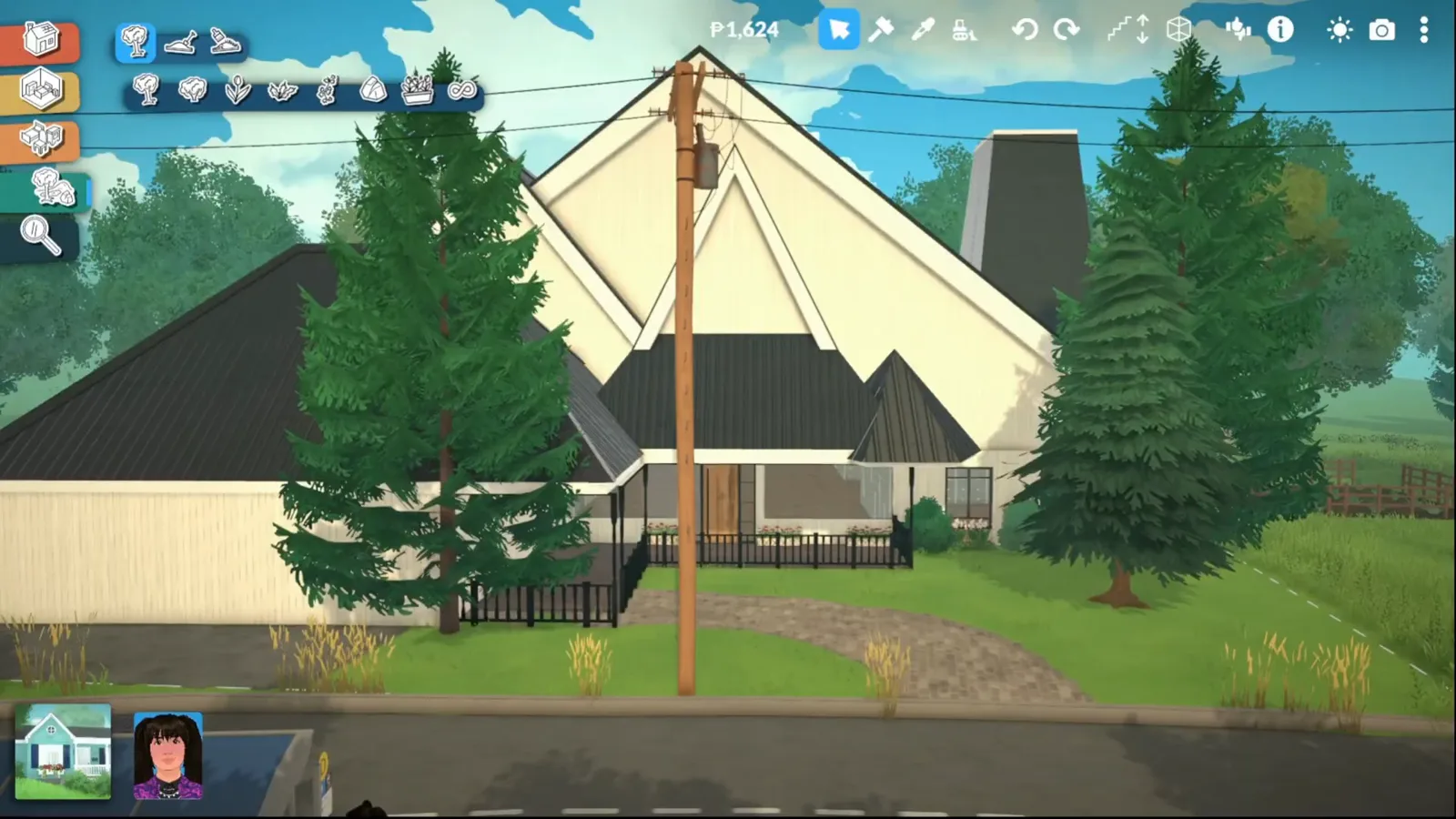
Mya Cove builds her dream farmhouse on one of Melino's empty Countryside lots — golden fields, a road, and the lot's plastic cows standing by. Hers is the other farmhouse silhouette: a low, wide multi-gable mass that gets repainted white over near-black once the shape is right.
- 12
Start from the golden field lot
Mya Cove builds on one of Melino's empty Countryside residences — golden fields straight down to the road, plastic cow statue included. Starting from fields instead of a downtown lot is half of what makes the finished house read as a farm.
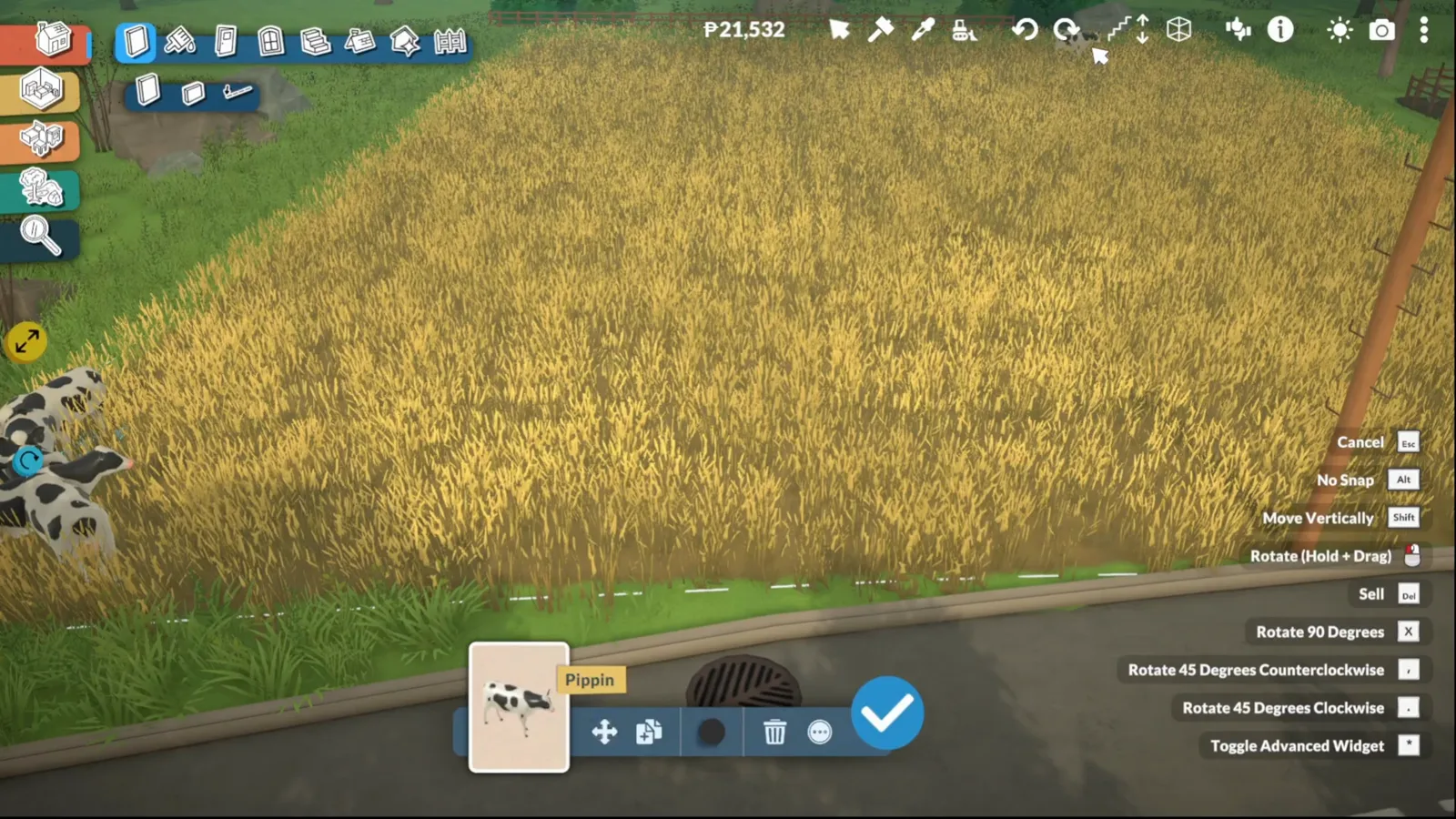
Golden fields, one road, one cow: the countryside canvas.Watch at 0:12 - 13
Stack roof sections into a multi-gable mass
Instead of one big roof plane, Mya stacks hip and gable pieces into a broken, stepped silhouette with a chimney shouldering through it. Roofs drag and resize freely in Paralives, so the mass can step down toward the porch without any custom pieces.
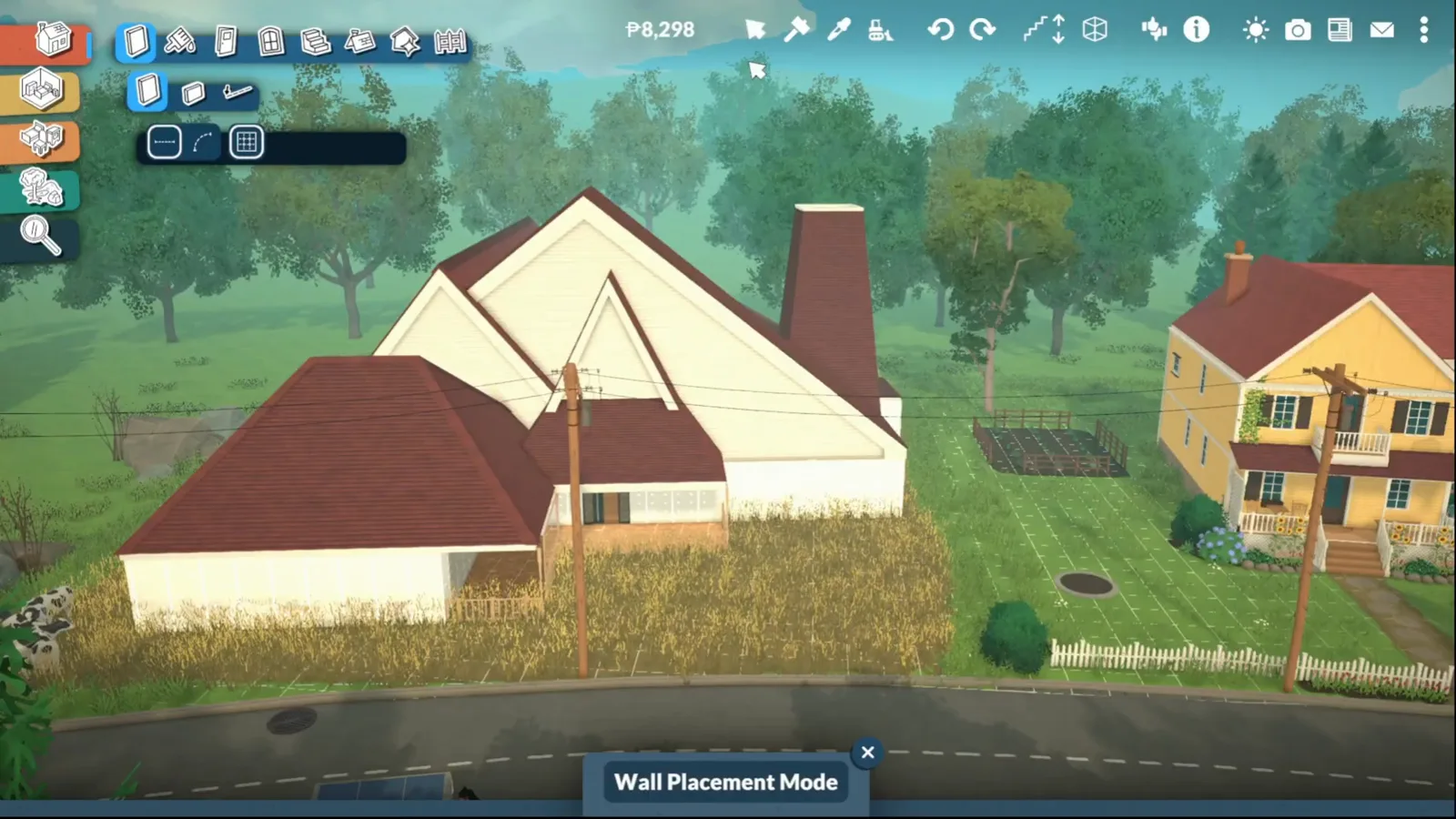
Broken rooflines read like generations of additions — very farmhouse.Watch at 16:45 - 14
Repaint the shell white over near-black
The same house ends in near-black roofs and pale siding: paint mode re-skins every wall and roof section in place, so trying the darker scheme costs nothing but swatches. If the first colour feels wrong, repaint — the shape was never the problem.
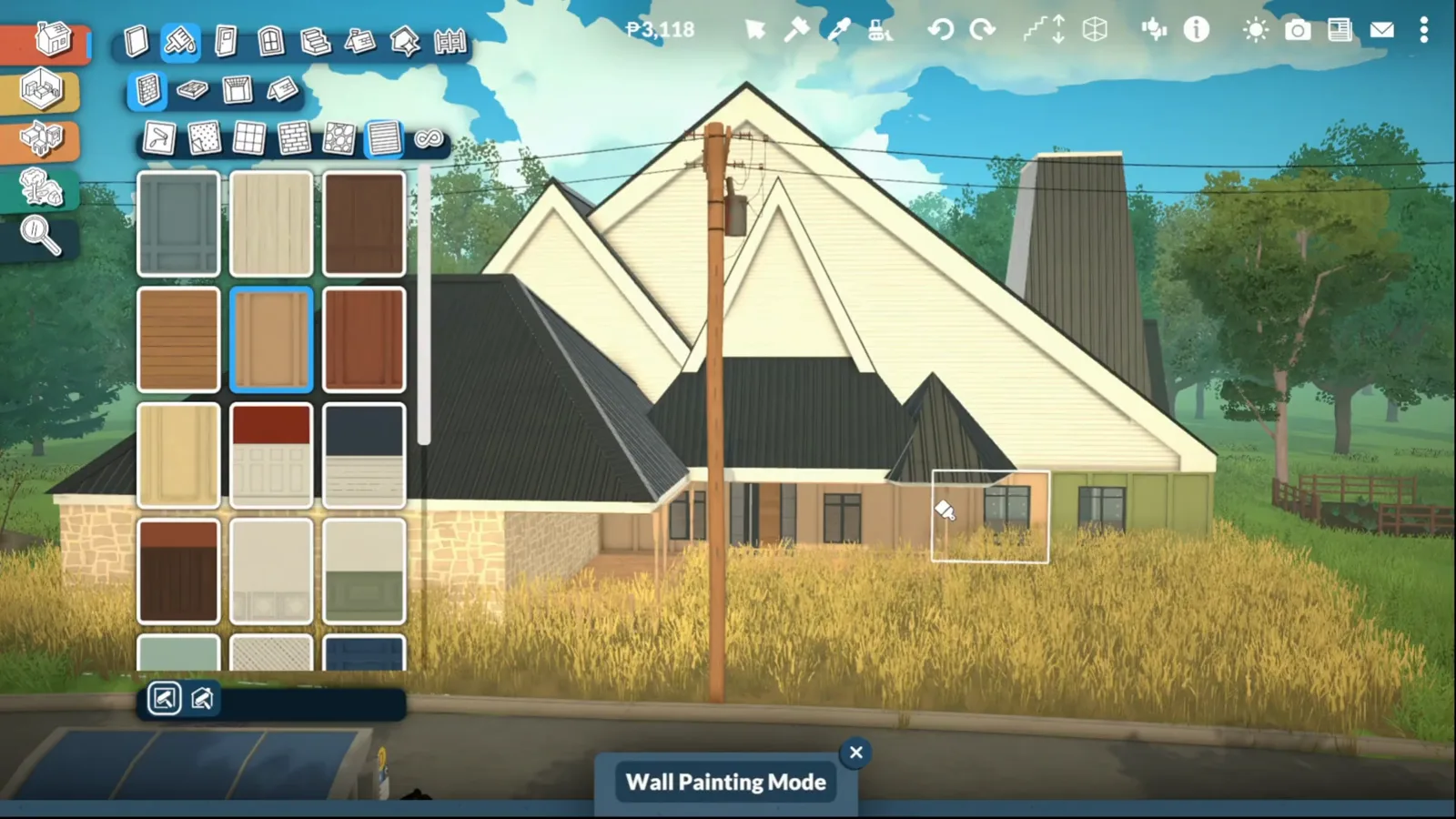
White over near-black: the repaint costs swatches, not a rebuild.Watch at 21:15
Quick route
The one-story cozy shortcut
Mosslight Nook's French-country speedbuild keeps every farmhouse sign — a flowering front border, an arch, an open kitchen — and drops the second story. Eight minutes of video is the fastest way to learn which few moves actually make a farmhouse.
- 15
Trade lawn for a flowering front border
Mosslight Nook skips the picket-and-plot stage at the front and plants instead: lavender and wildflower clumps dropped straight into the grass edge until the lawn reads as a meadow. It is the fastest farmhouse-garden move in this guide.
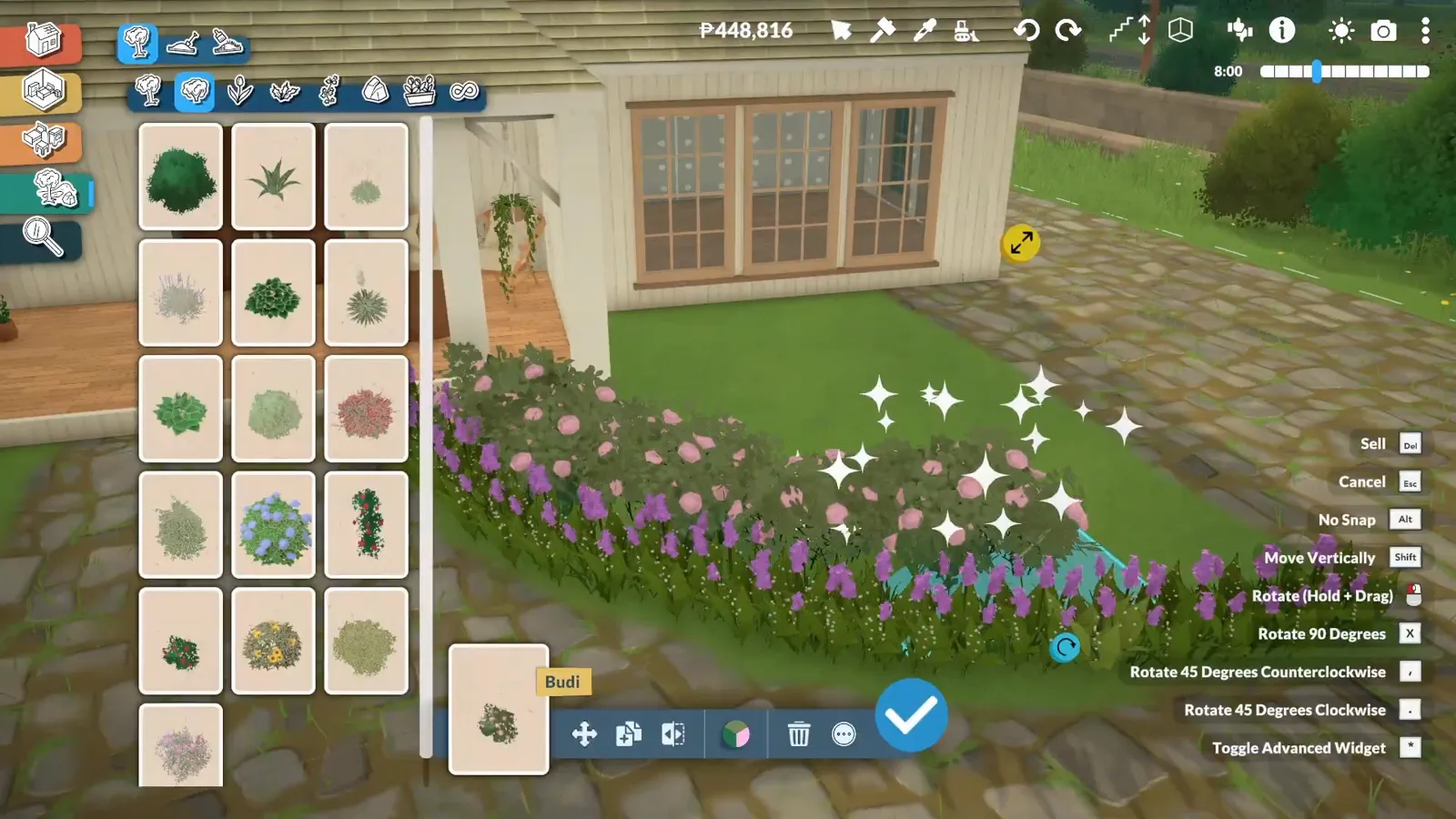
A flowering front border does the work of an entire garden.Watch at 0:41 - 16
Open the kitchen to the hall under an arch
The one-room-deep plan lets the kitchen open straight toward the entry under a tall arched door, with bar stools at the island and stone on the chimney wall. Smaller plan, same heart — proof the farmhouse look does not require two stories.
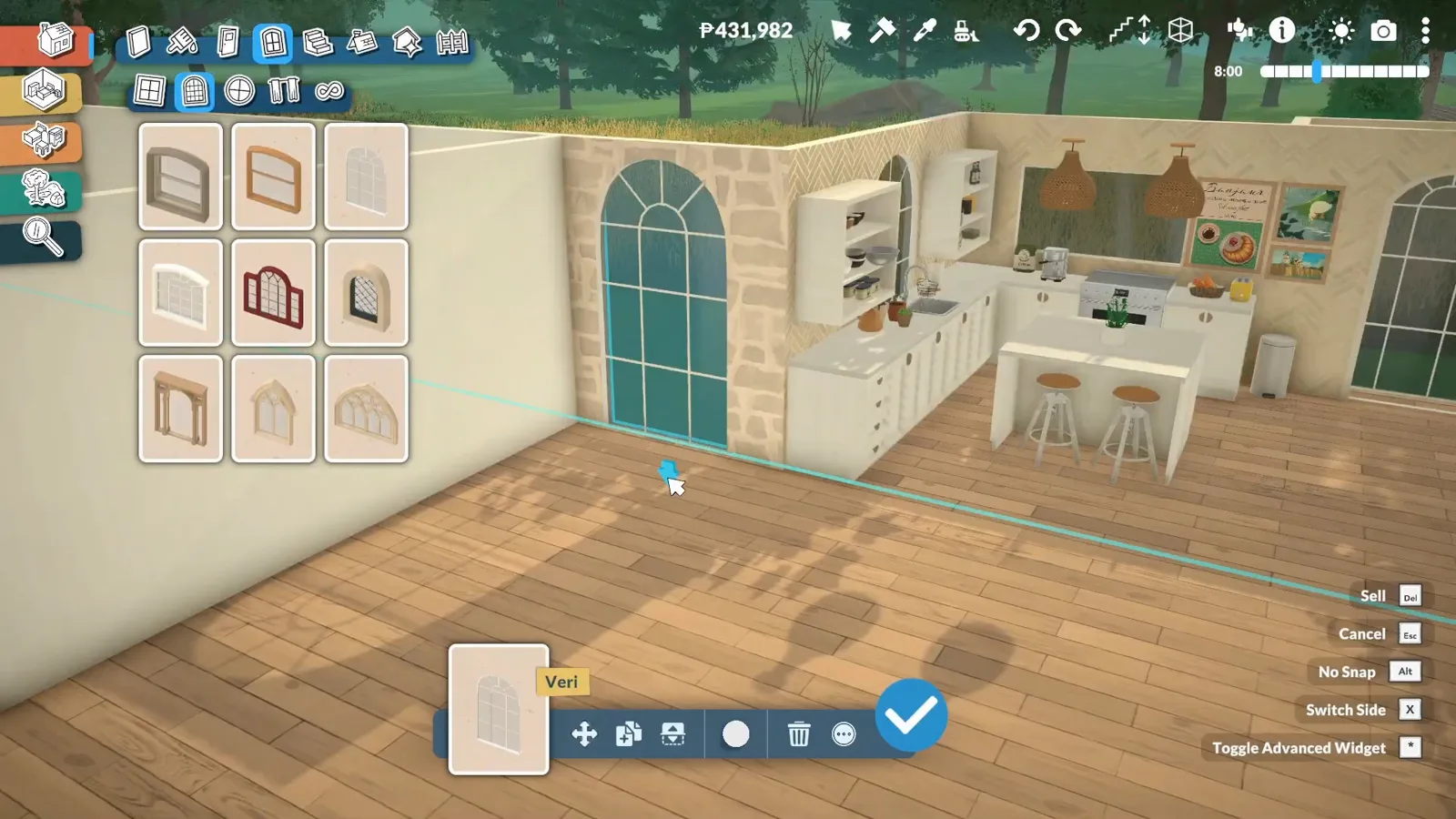
One deep room: kitchen, island, arch — the small plan keeps the same heart.Watch at 3:17
Farmhouse FAQ
- Is there an official farmhouse template in Paralives?
- No — farmhouse is a player style, not a preset. The wiki's list of Melino lot types has no farm category, only residences, shops, parks and similar, so the look is something you build yourself. The classic canvas is an empty Countryside residence such as 418 Golden Field Road, a golden-field lot that has been in the game since patch 0.1.1, plastic cows included.
- Can you actually grow crops on a Paralives farm?
- Not yet. A gardening system — seeds, watering, harvests that could tie into cooking — is on the studio's roadmap for after Early Access, but it is not in the game. The convincing field rows in these builds are set dressing: planter boxes ranked along a dirt strip painted with the terrain tools. Nothing to water, nothing to harvest.
- Where do the cows come from? Can you keep animals?
- The cows in these videos are not livestock — they are decorative plastic cow statues that ship with certain empty lots in the Countryside. Mya Cove's golden-field lot came with a set, laney's yard has one stationed by the fence, and the studio's own lot showcase joked that you have to keep the plastic cows when you build there. Actual animal husbandry does not exist in the game.
- How long does a farmhouse take to build?
- Longer than the speedbuilds suggest. Mya Cove says in her commentary that she was roughly two hours in — on the exterior alone — before taking a food break, and laney's video compresses a full two-story build with complete interiors into about 90 minutes. Treat a dressed farmhouse as an evening project, or split it: shell and yard first, interiors another day.
- Is a farmhouse the same as a cottagecore home?
- They overlap but aim differently — this is our editorial split, not game wording. A farmhouse is built around working shapes: a wraparound porch, a mudroom, planter rows, a fenced yard that pretends to feed the house. Cottagecore is built around romantic overgrowth: wildflowers, soft light, cozy clutter. Many lots happily do both, and our cottagecore guide covers that side.
- Any famous farmhouse inspiration worth copying?
- Rudi Rennkamel's first Paralives build is the Weasleys' Burrow — the crooked magical farmhouse, rebuilt as a stack of wonky roofs and off-angle walls. In his commentary he credits the free-dragging roofs and the advanced move tool for making the lean possible, something he calls virtually impossible in several other builders. Good proof that farmhouse does not have to mean straight and symmetrical.
Go deeper
More house ideas
A catalogue of buildable home concepts with links out to the deep guides — the farmhouse is one entry on a much longer list.
Cottagecore build guide
The romantic cousin of the farmhouse: wildflower borders, soft light and cozy clutter. The working yard's prettier other half.
Terrain tools guide
Paint the dirt paths, flatten the yard, sink the field — the terrain kit is what makes planter rows read as farmland.
Related guides
Roof building guide
Gables, hips, dormers and free resizing — the mechanics behind both farmhouse rooflines in this guide.
Decks and patios
The wraparound porch is a deck with posts. This guide covers the deck half of that sentence in detail.
Victorian house guide
If the multi-gable roof mass hooked you, the Victorian look pushes the same idea further with trim and towers.
Loft guide
A farmhouse attic is a loft wearing a hat — the same open-half-floor tricks, applied under the gable.
Pool guide
Not every yard job is dirt and fences: the same terrain and deck tools dig the swimming hole too.