
The short version
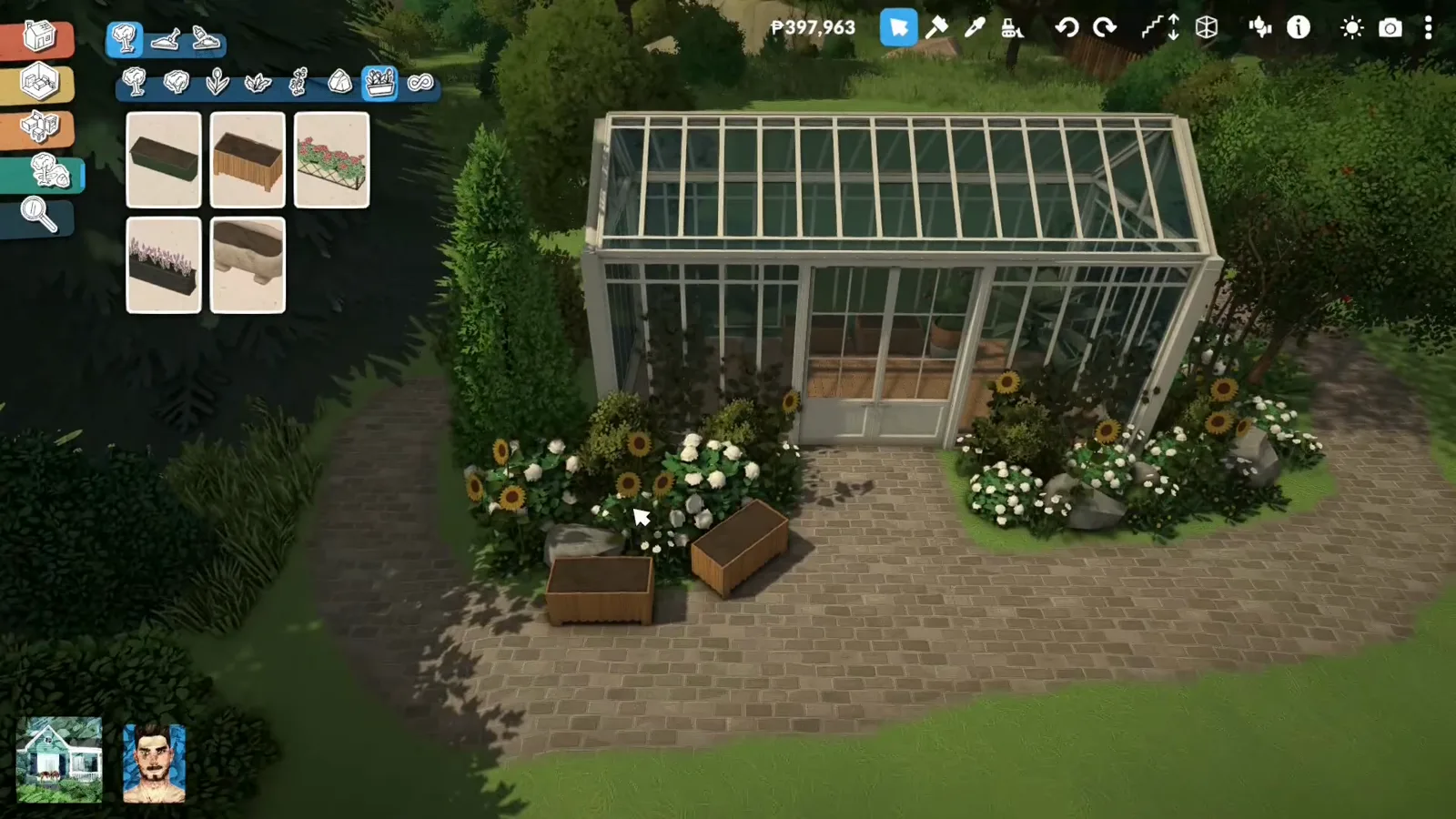
Paralives has no greenhouse part. The walls are window pieces set side by side, the roof is the same windows rotated onto the pitch with the advanced widget, and the gables close with the triangular and trapezoid panes from the shaped-window tab. Everything around the glass — the paved approach, the flower border, the troughs inside — is terrain paint and plant variants. The hard part is not the look. It is keeping the glazing in place.
- No conservatory item exists: fill the wall runs with tall windows and leave solid corner piers to frame them.
- The glass roof is that same flat window rotated onto the slope — nothing snaps it centred, so the rows go in by eye.
- The shaped-window tab carries the triangular and trapezoid panes that close a gable apex.
- Editing a wall's height or thickness deletes custom-placed windows; the builder who learned this laid her glass roof last.
- The surrounds come from Terrain Paint Mode and the Select a variant dialog, not from paving or hedge objects.
- No mods in either build — the narrated one uses a single cheat, to move a power line off the front of the lot.
Shell & glazing
Walls that are mostly windows
The whole trick is that a greenhouse is not a build type — it is a single-storey rectangle whose walls have been replaced. Keep two solid corners, drop the door in while the wall is still there, then run window pieces edge to edge until the shell is glass you can walk through.
- 1
Lay the solid corners first
The greenhouse starts as any room does: two wall runs meeting at a right angle in Wall Placement Mode, laid out on the build grid in a grey speckled wall material. Those corner walls survive into the finished build — the glazing goes between them, not instead of them. Nothing on screen is a greenhouse part; it is the ordinary wall tool, kept to a single storey.
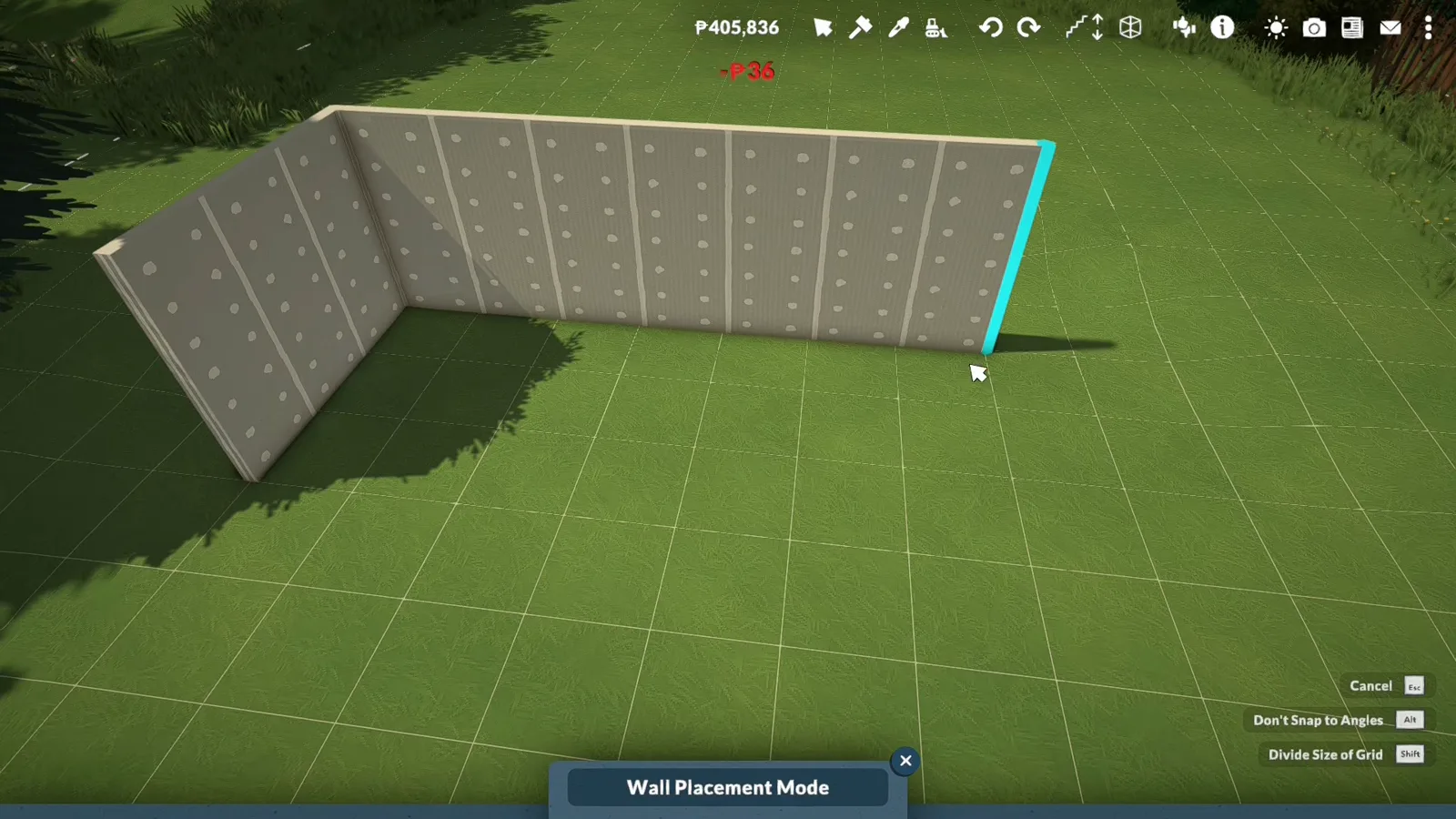
Corner piers first — the glass slots in between them later.Watch at 0:06 - 2
Set the double doors while the wall is still solid
The entrance is a multi-lite glass double door from the doors category, dropped into the wall before the glazing closes in around it; by the finished build the windows have crept up either side and the doors are the only opening left in that face. The frame catches the door with the advanced widget on it, which is how it gets nudged flush with the wall. Solid lower panels keep a sill line where the glazed walls have none.
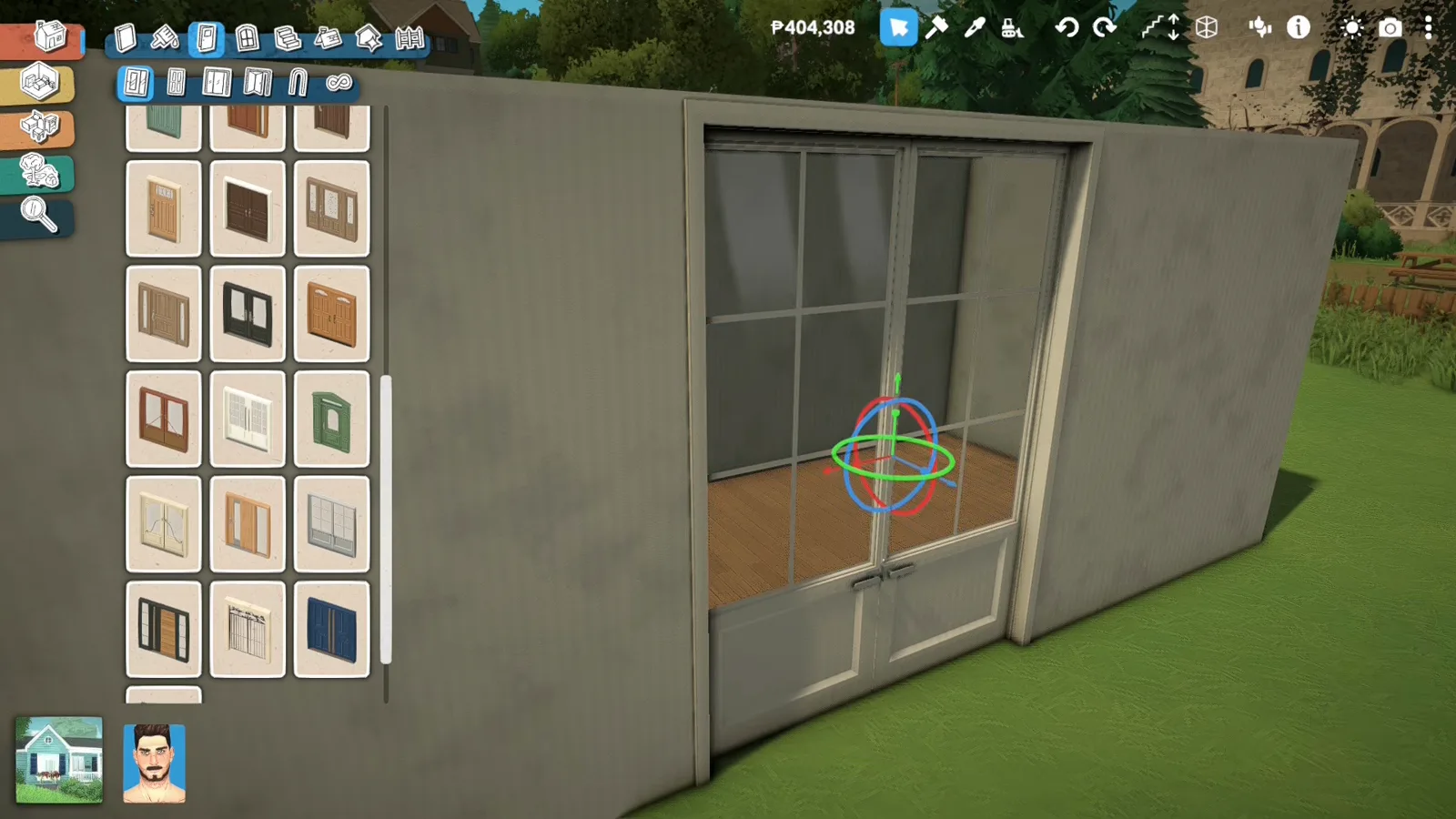
Door first, glazing second — the wall around it is still whole here.Watch at 0:26 - 3
Replace a whole wall run with tall windows
With the end wall selected, the window catalogue stays open on its first tab and the run fills with floor-to-ceiling window pieces, mullion against mullion, until the wall is mostly glass. The tray under the selection carries the move, duplicate, resize and colour buttons, and its tooltip labels the piece Chani. Blue handles sit on all four sides of the selection, showing which directions the run can still be pushed.
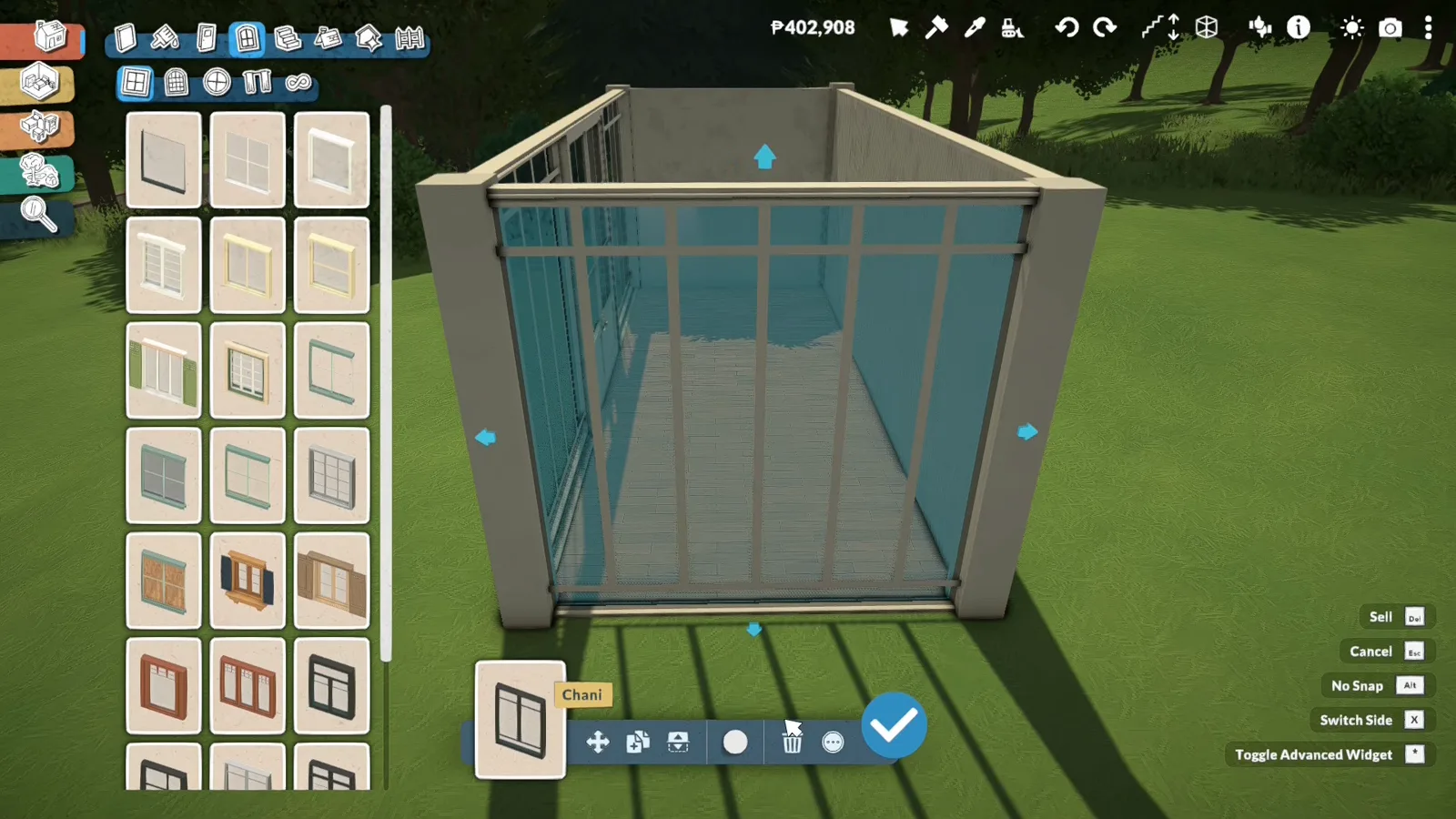
One window at a time until the wall stops being a wall.Watch at 1:16 - 4
Run the same glazing down the long sides
The long wall gets the identical treatment: a continuous band of tall windows with the plank floor visible straight through the building. Because every bay is a window item rather than a wall, light reaches the room from three sides, and the floor can be laid while the shell is still open to the sky. This is the point where the structure stops reading as a shed with windows in it and starts reading as a glasshouse.
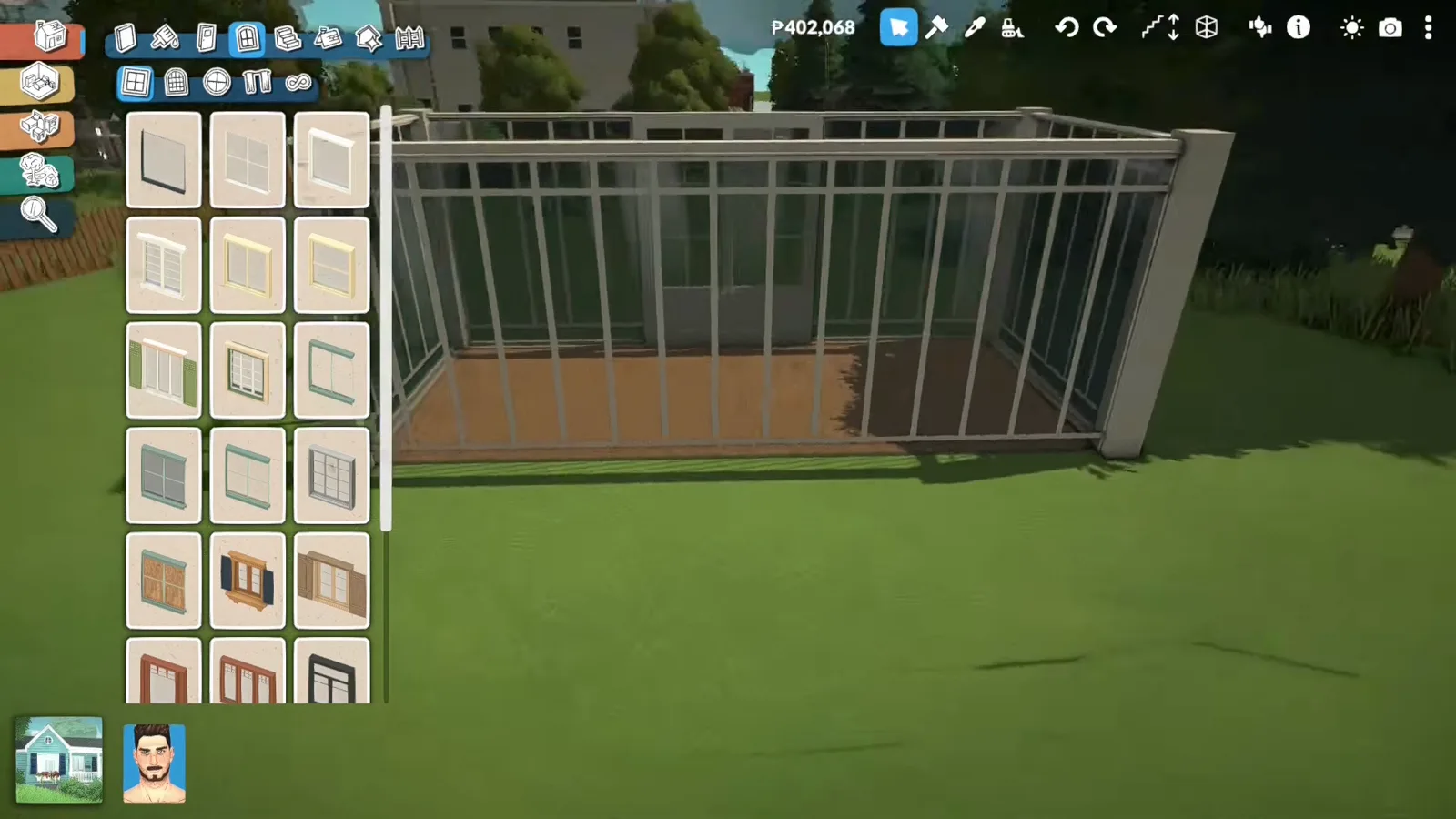
Three glazed sides, no roof yet — the floor is already down.Watch at 1:26
Glass roof
Laying the pitch out of window pieces
This is the part that makes it a greenhouse rather than a room with a lot of windows, and the game has no item for it. Flat windows go onto the slope, the advanced widget tilts them, and the shaped tab supplies the one pane that fits a gable apex. Alignment is by eye — there is no snap waiting to rescue you.
- 5
Frame the gable before you glaze the pitch
The end walls rise to a triangular frame at roof height, and the catalogue switches to the shaped-window tab: round, octagonal, triangular, trapezoid and half-moon panes, none of which belong on a rectangular wall. The whole gable end is lit up cyan and a guide line runs off across the screen at the height the two roof planes will meet. Get this frame honest first — the glazing in the next three steps only has to follow it.
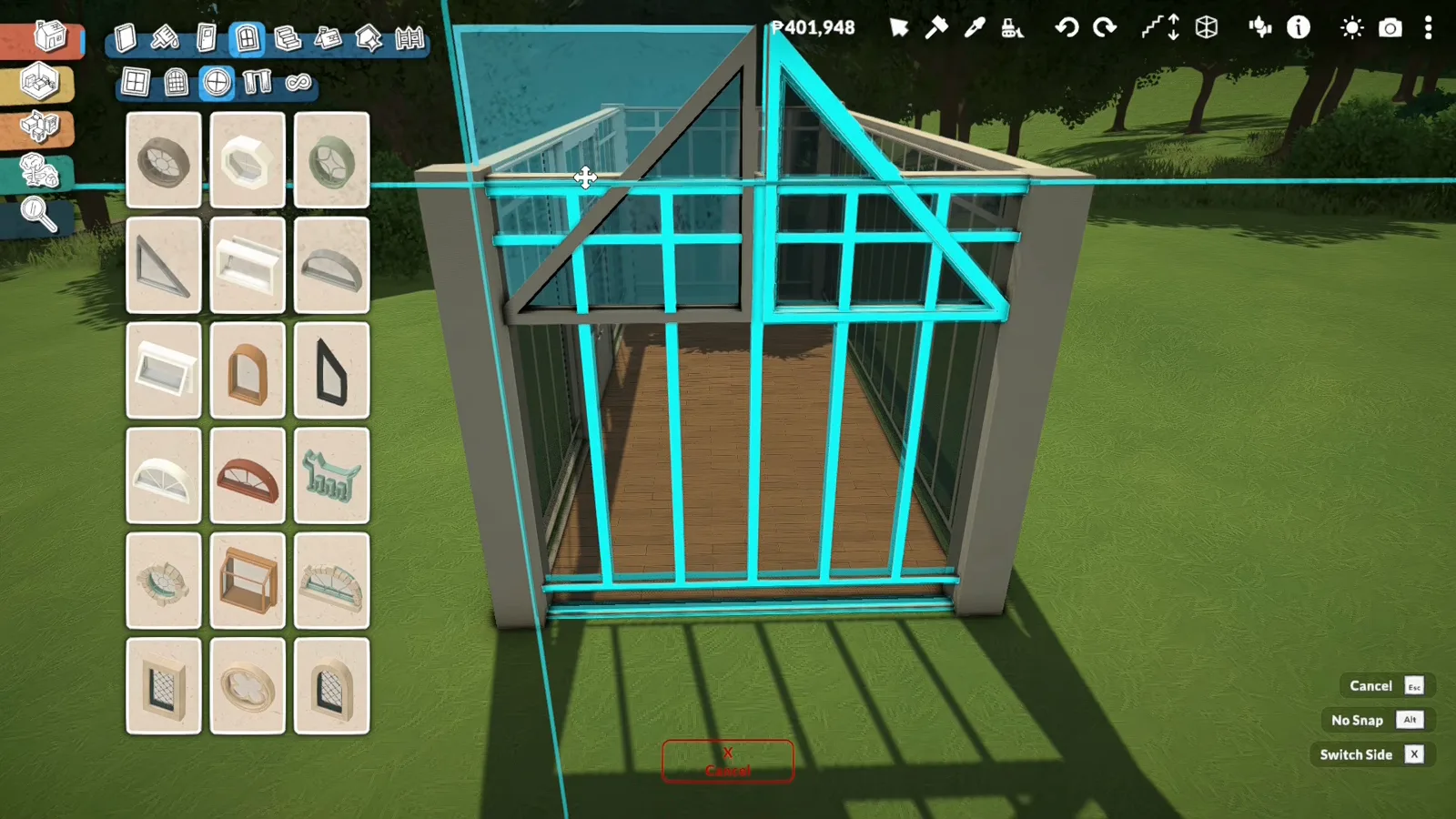
The shaped-window tab exists for exactly this apex.Watch at 1:33 - 6
Lay the roof out of the same flat windows
There is no glass roof item, so the pitch is filled with the same flat window pieces used on the walls, laid in rows down each slope and positioned with the advanced widget. The ridge is still open here: the last row on each side has to reach it without overlapping its mirror image. The mullion shadows thrown across the grass are the giveaway that this is glazing on a roof, not tiles.
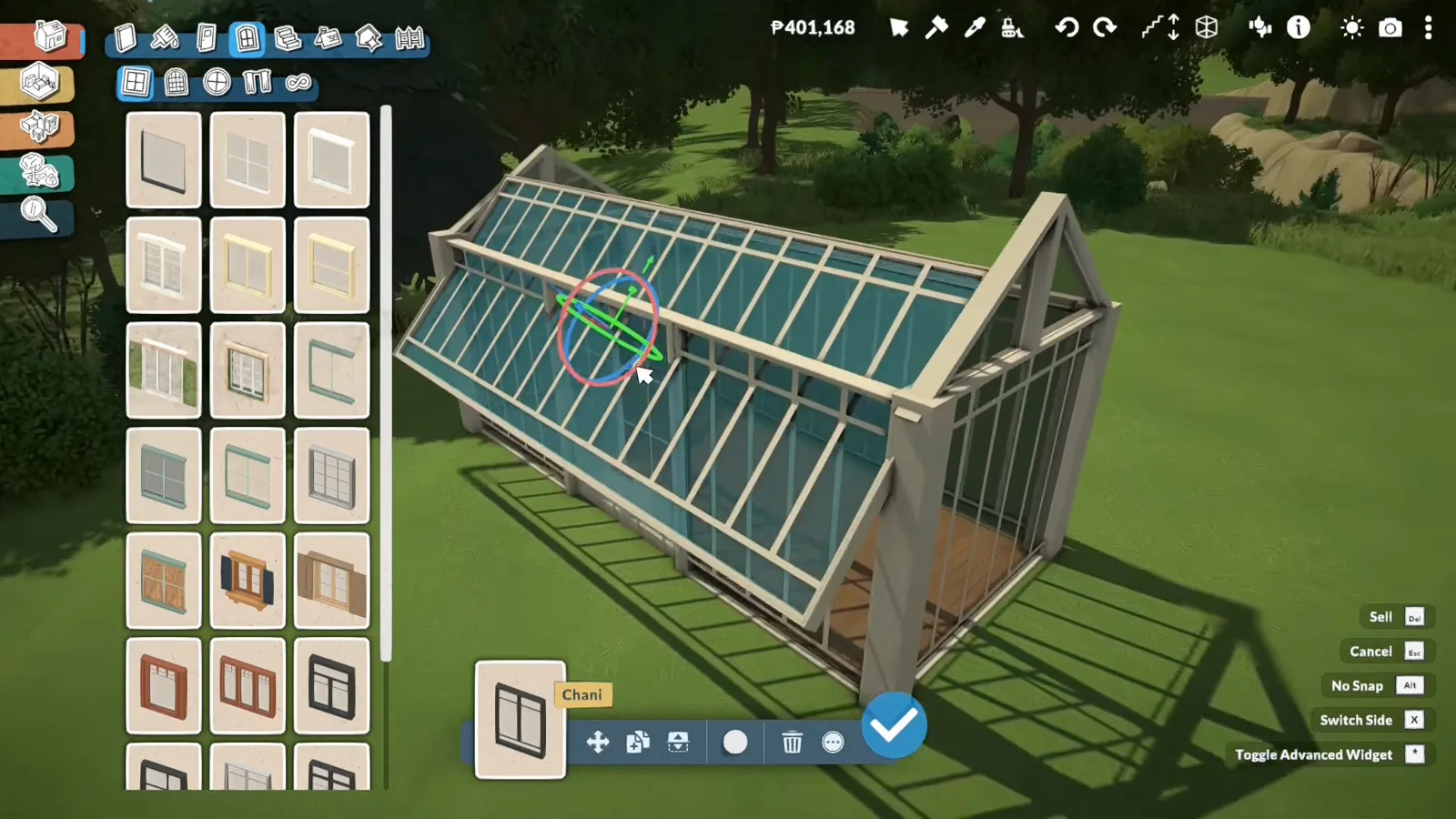
The same window, tilted onto the slope, row by row.Watch at 2:32 - 7
Close the ridge and step back
Seen from above the envelope is complete: two glazed slopes, glazed ends, glazed sides, with only the corner piers and the lower door panels left solid. The widget is still on the ridge piece, which is the fiddliest join in the build — two runs of glazing meeting along a line nothing centres for you. The narrated builder further down this page puts it plainly: the advanced widget gives you so much freedom of movement and no way to place anything exactly, so it is all done by eye.
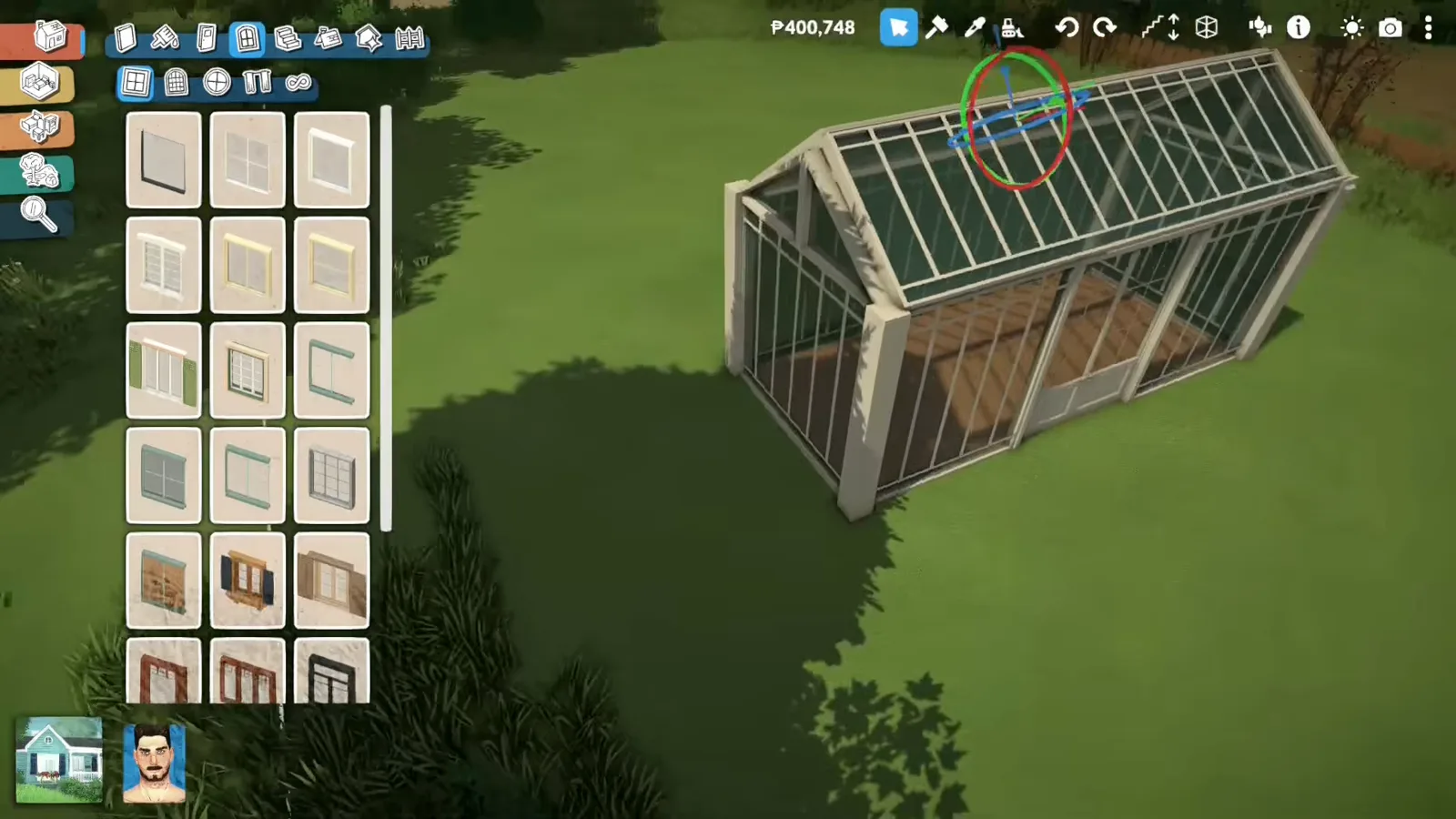
Ridge closed: everything except the corner piers is glass.Watch at 3:20 - 8
Finish the apex with a triangular pane
The gap left at the top of the gable is not a shape the rectangular tab can fill, so the last piece is a triangle, dropped in and nudged with the four move handles until its edges sit under both roof lines. The tray tooltip reads Chani — the angled version of the same window style the walls are glazed with. It is a small pane doing a lot of work: the apex is what decides whether a glass gable reads as designed or as patched.
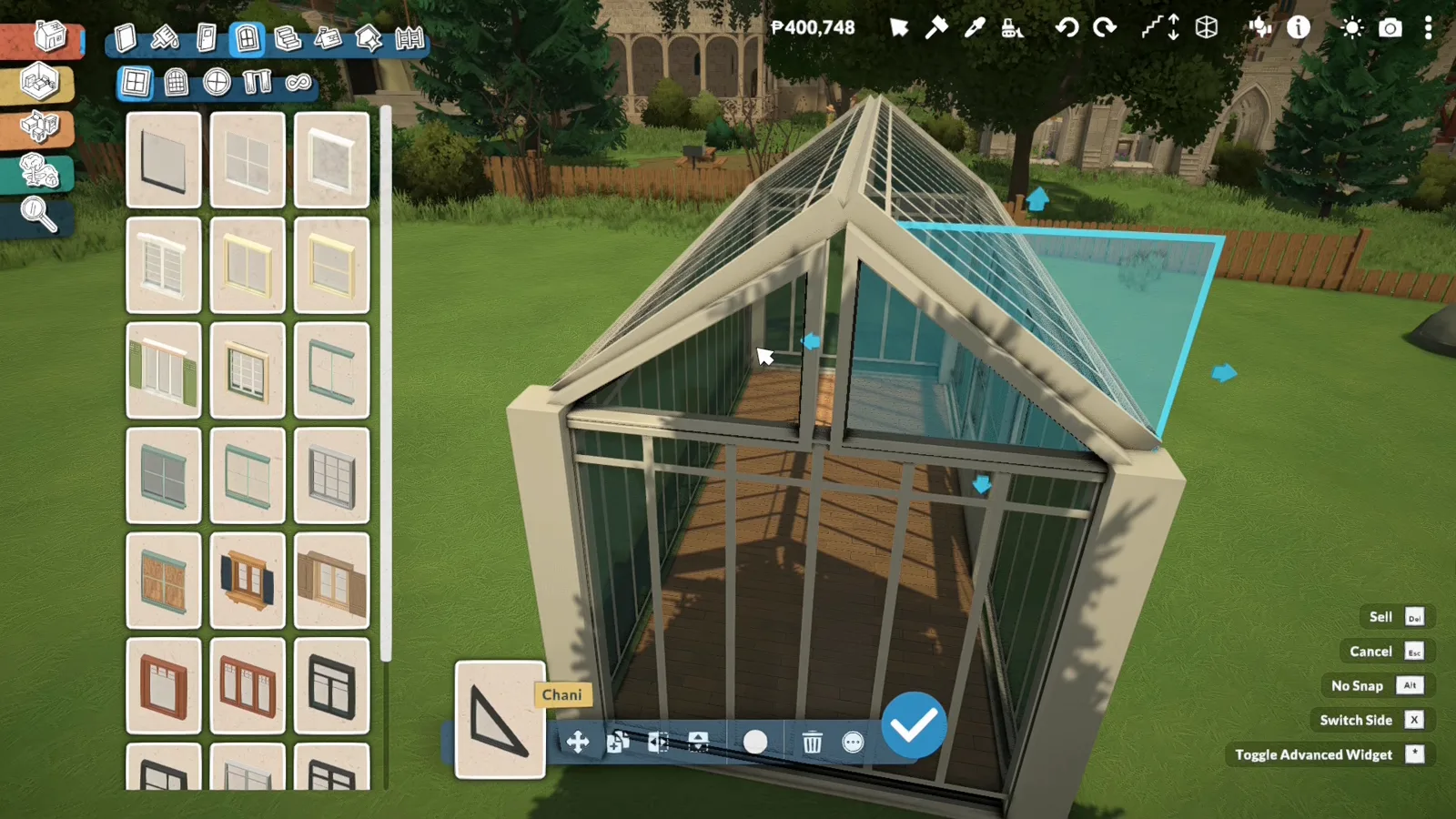
One angled pane closes the gable; everything else is already glass.Watch at 3:31
Surrounds
Paving, variants and a border that spills
Glass alone reads like a swimming pool enclosure. What sells it as a greenhouse is the ground around it: painted brick under the doors, flowering shrubs varied one plant at a time, and flower clumps rotated and pushed over the paving edge so the planting looks older than the build.
- 9
Vary one shrub instead of buying variety
The planting around the glass leans on the Select a variant dialog: the same flowering shrub offered in six densities of leaf and bloom, so a row of one plant reads as a row of several. Swapping variants keeps the border coherent — different species side by side is what makes a garden look stocked rather than grown. Behind it the finished shell sits with its doors centred and the glazing closed up to the ridge.
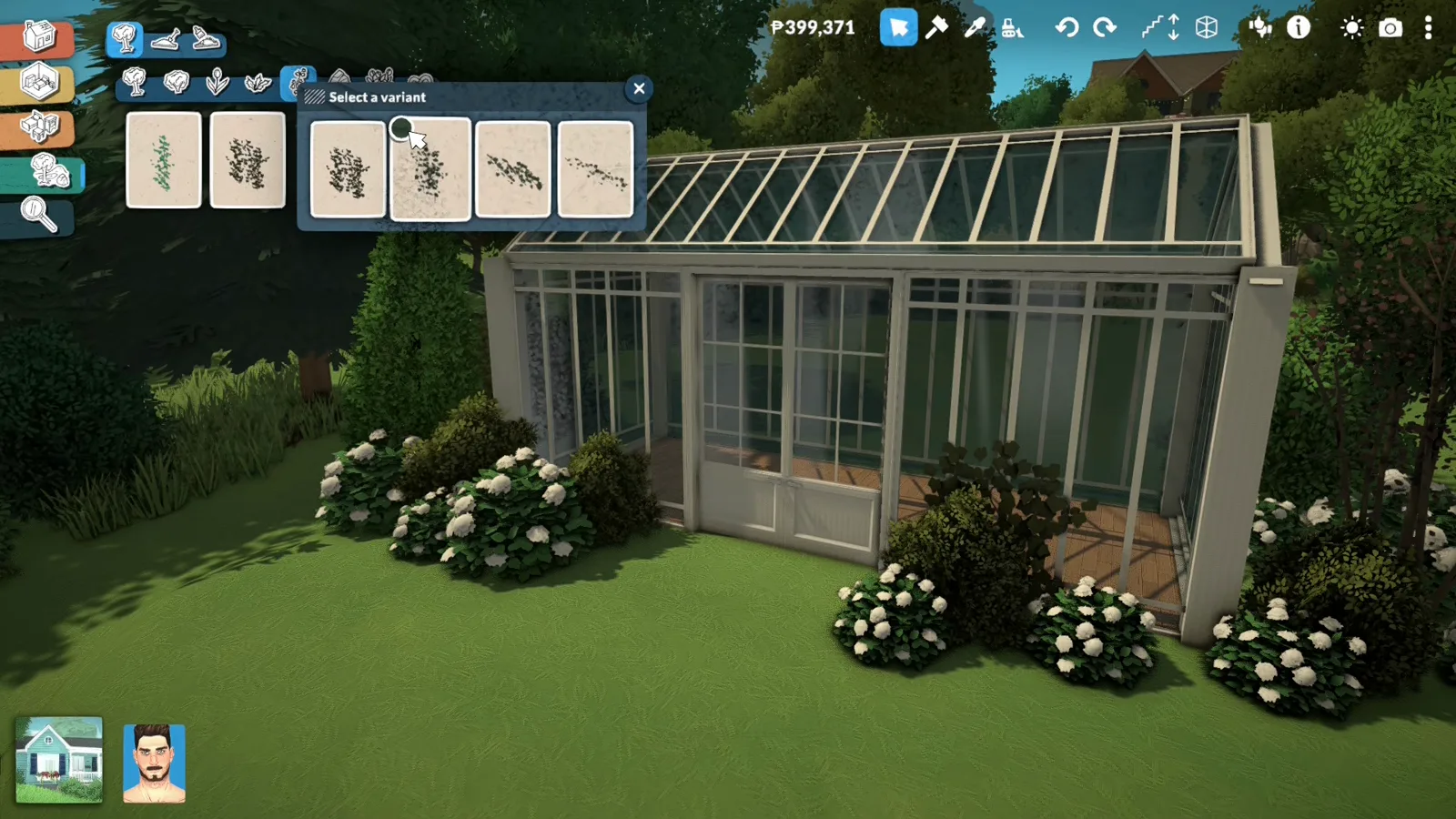
Six variants of one bush beat six different bushes.Watch at 5:00 - 10
Paint the approach instead of paving it
The path is Terrain Paint Mode, not laid paving objects. The surface palette on the left carries grass, dirt, gravel, cobble, asphalt and brick pavers — the selected swatch is the one outlined in blue — and a round brush stamps it onto the lot. Painted ground follows the slope exactly and its edge can curve wherever the planting needs it to, with no joints to align. The top-down angle is the honest way to lay an approach: from ground level you cannot see where the edge lands.
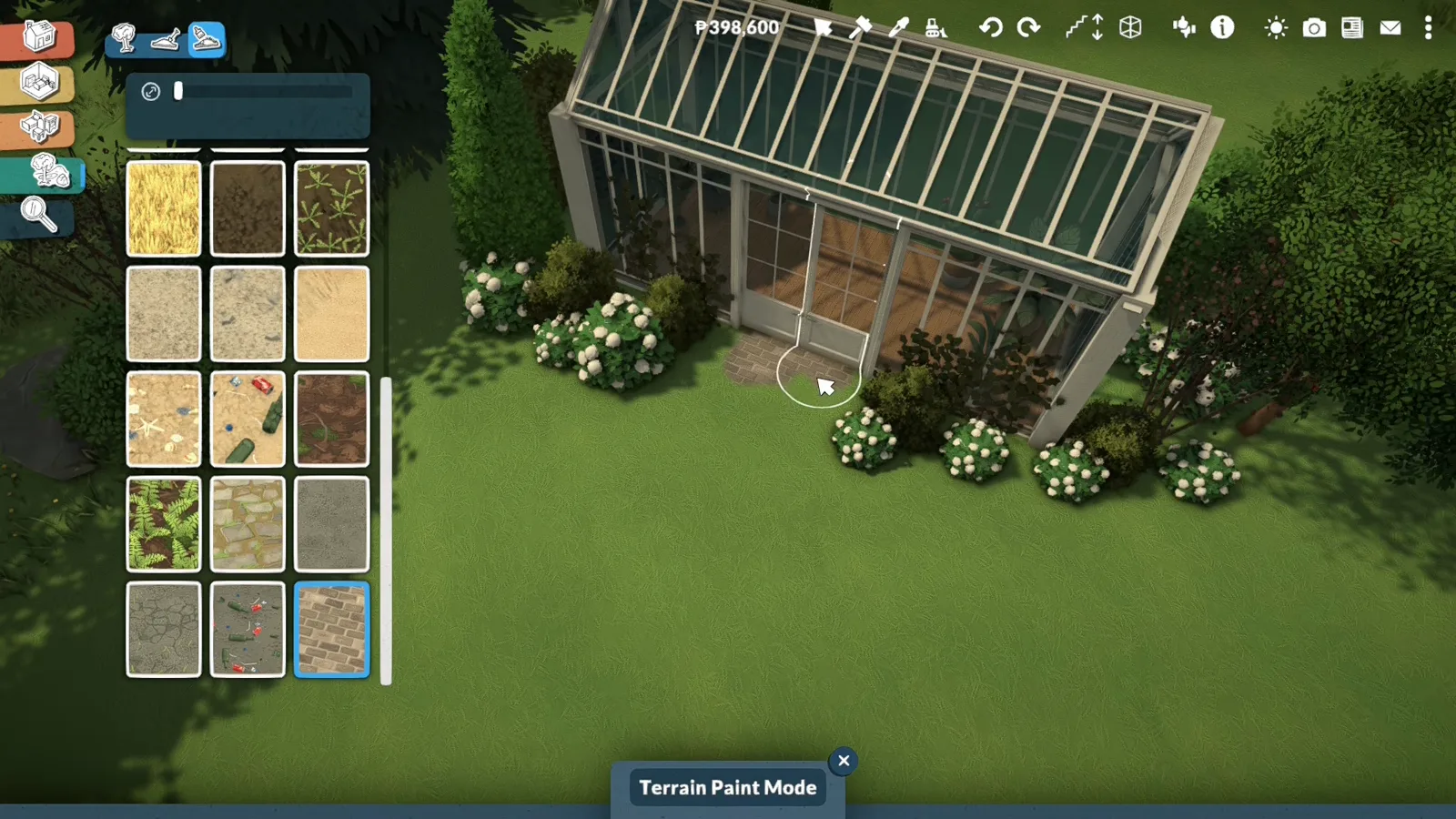
The apron is painted terrain; the white circle is the brush.Watch at 5:35 - 11
Spill the border over the paving
Flowers come from the ground-plant tab of the plants catalogue — clumps of daisies, sunflowers, roses and wild mixes — and each one is rotatable: the placement HUD in this frame lists hold-and-drag rotation plus 45-degree and 90-degree turns. Boulders and the taller white-flowering bushes anchor the corners, and the small clumps go in so their grass footing overlaps the painted brick. A border that stops exactly at the paving edge is the tell of a first pass.
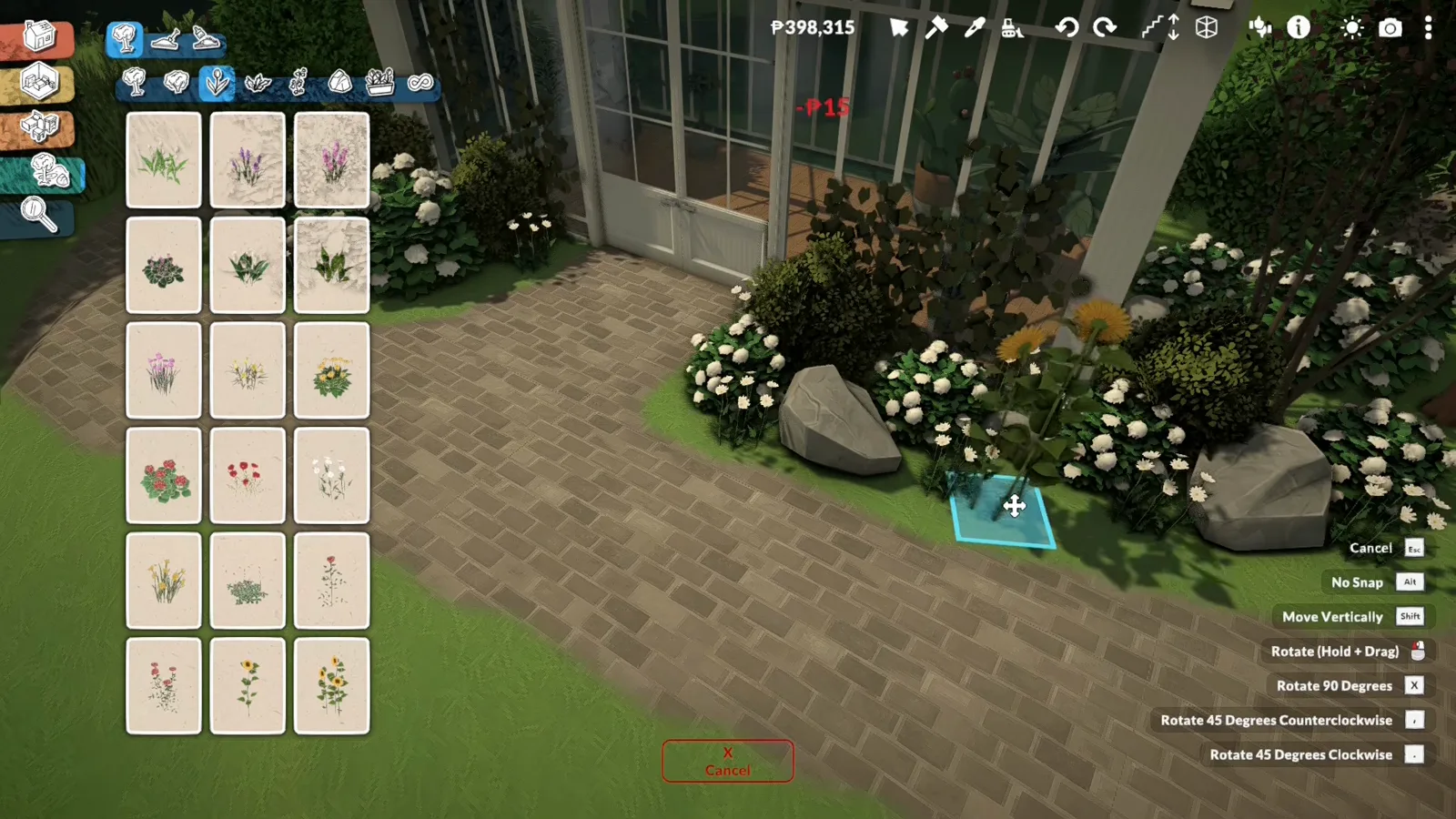
Rotate the clumps, then let them grow across the edge.Watch at 6:25
Sunroom wing
A glass gable on a cottage — and what it costs
The second build glazes a wing onto an existing house instead of building a freestanding glasshouse, and it is narrated, so the difficulties are documented out loud: panes that will not centre, a glass roof that vanishes every time something nearby is edited, and a tower that had to stop being a square so its roof would fit around a room she still wanted to use.
- 12
Open the shaped-window tab for the awkward walls
intothesimulation adds her greenhouse as a wing onto a hillside cottage, and the same catalogue tab does the work: round, octagonal, triangular, trapezoid and half-moon panes for the wall shapes a rectangular window cannot cover. Two angled pieces are already in on the tower's upper wall here, one still selected, with the roof-plane guide line crossing the screen behind it. Her note on placement is worth taking seriously before you commit to a big glazed gable — with that much freedom of movement there is no way to centre anything, so panes get lined up to the roof by eye.
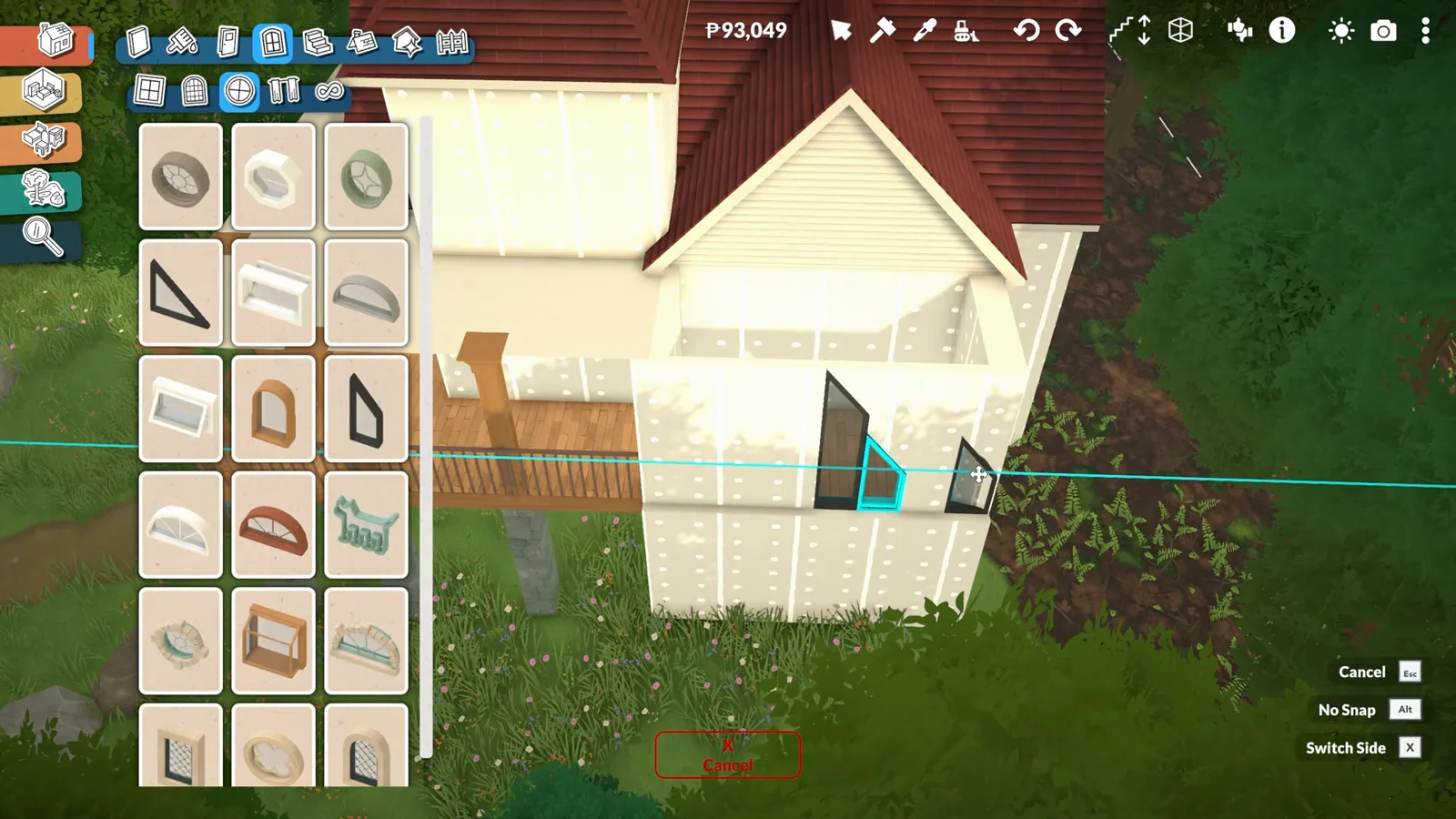
Trapezoid and triangle panes exist for walls a square window can't cover.Watch at 8:10 - 13
Position the gable triangle with the widget
The triangular pane goes high in the gable, and the rotation ball is on it, because this is the piece that has to sit level with two roof lines at once. The item tray labels it Chani — the same angled shape closing the apex of the freestanding greenhouse above. It is also the kind of placement that does not survive everything: the builder reports that changing a wall's height or thickness wiped out the custom-placed windows around it, more than once in one session.
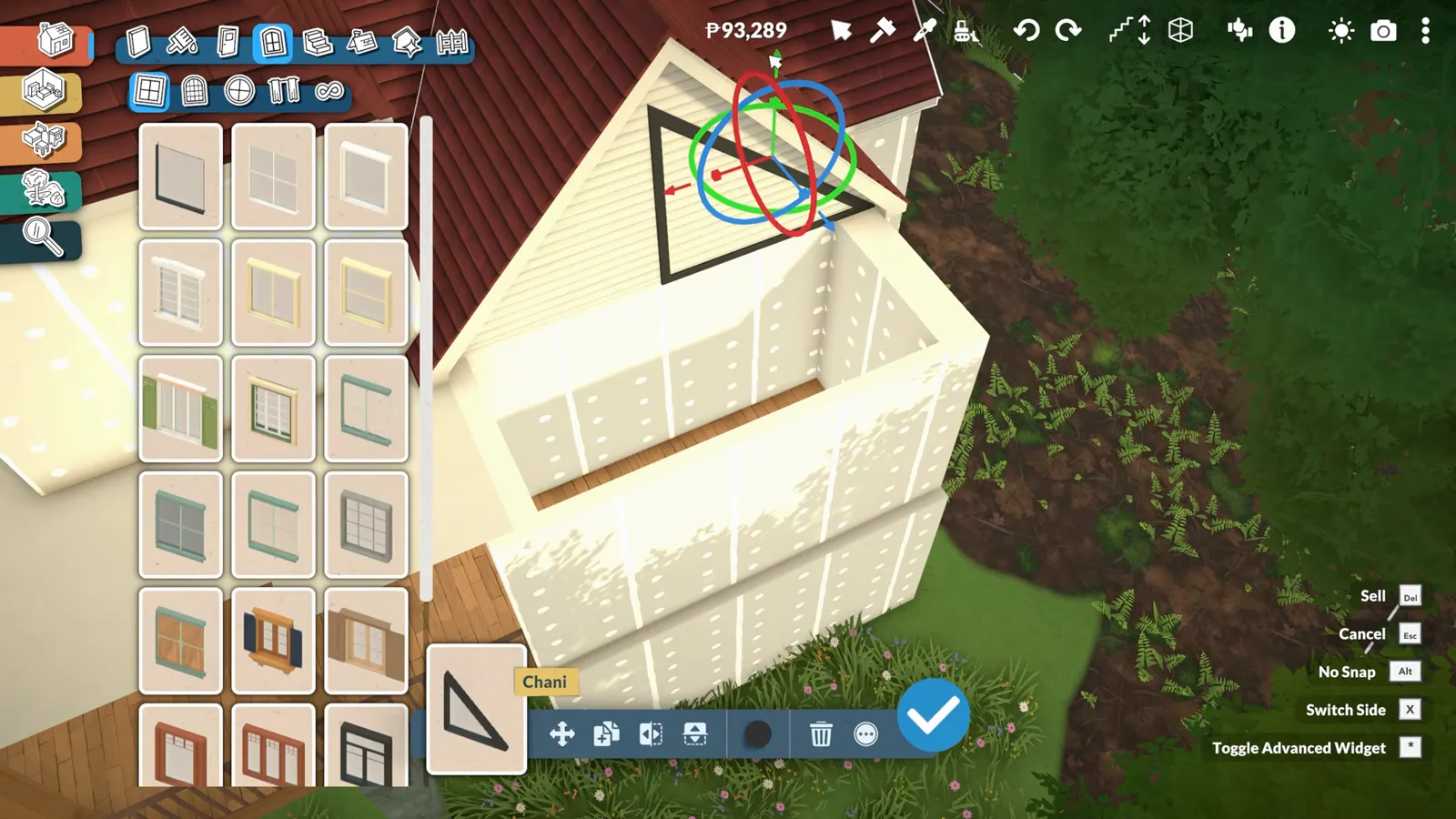
One pane, two roof lines to satisfy, and no snap to help.Watch at 8:25 - 14
Glaze the end from floor to ridge
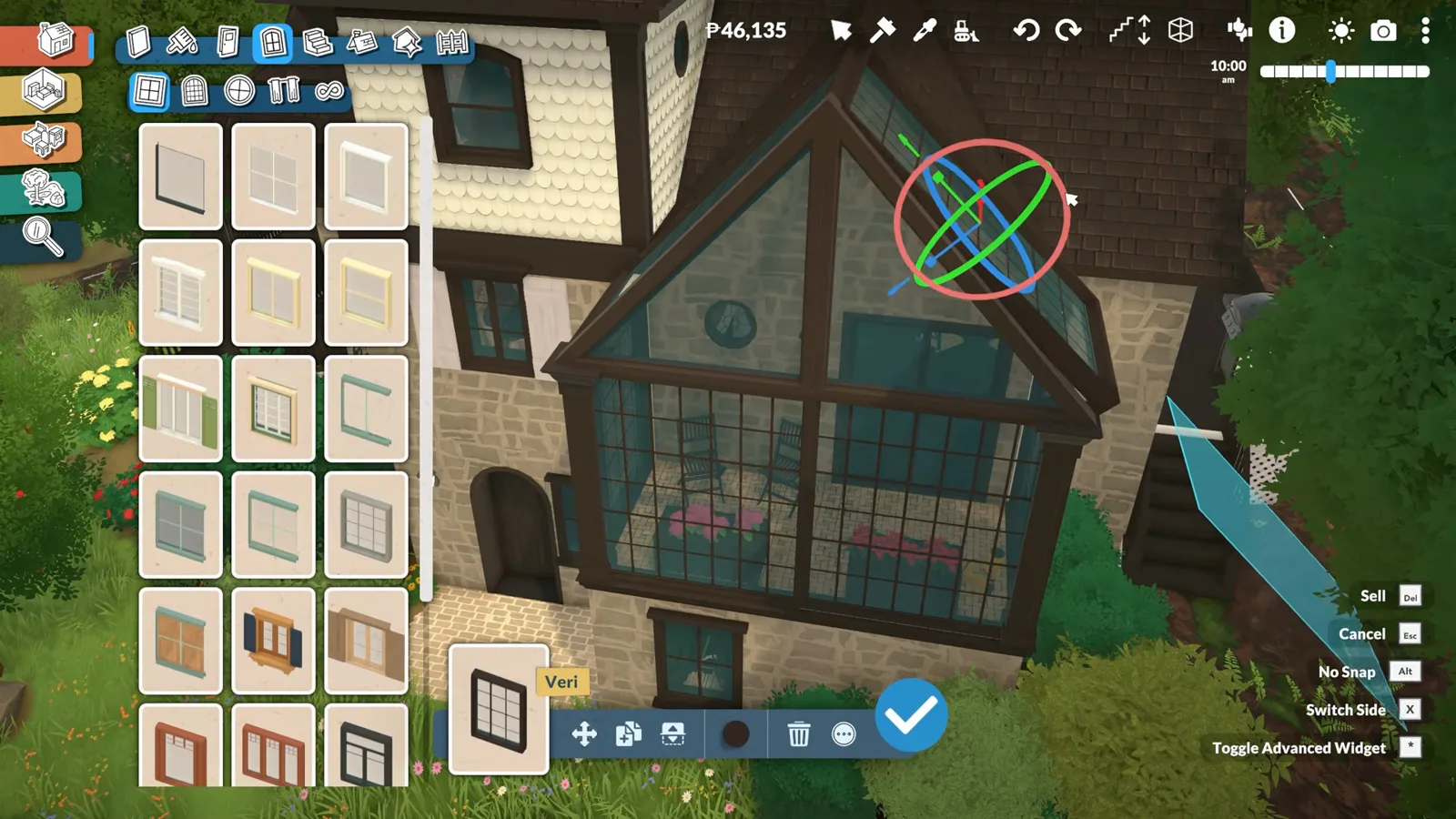
Here the wing's end becomes one continuous sheet: the same multi-lite window, labelled Veri in the tray, stacked across the wall and then up the pitch, so the roof of the sunroom is built from the same item as its walls. That continuity is what makes the space read as a greenhouse rather than a room with a skylight — and it is also the most fragile part of the build. In the video this glazing goes away every time something near it is edited, which is why it was rebuilt so often that the builder eventually stopped replacing it until the end of the session.
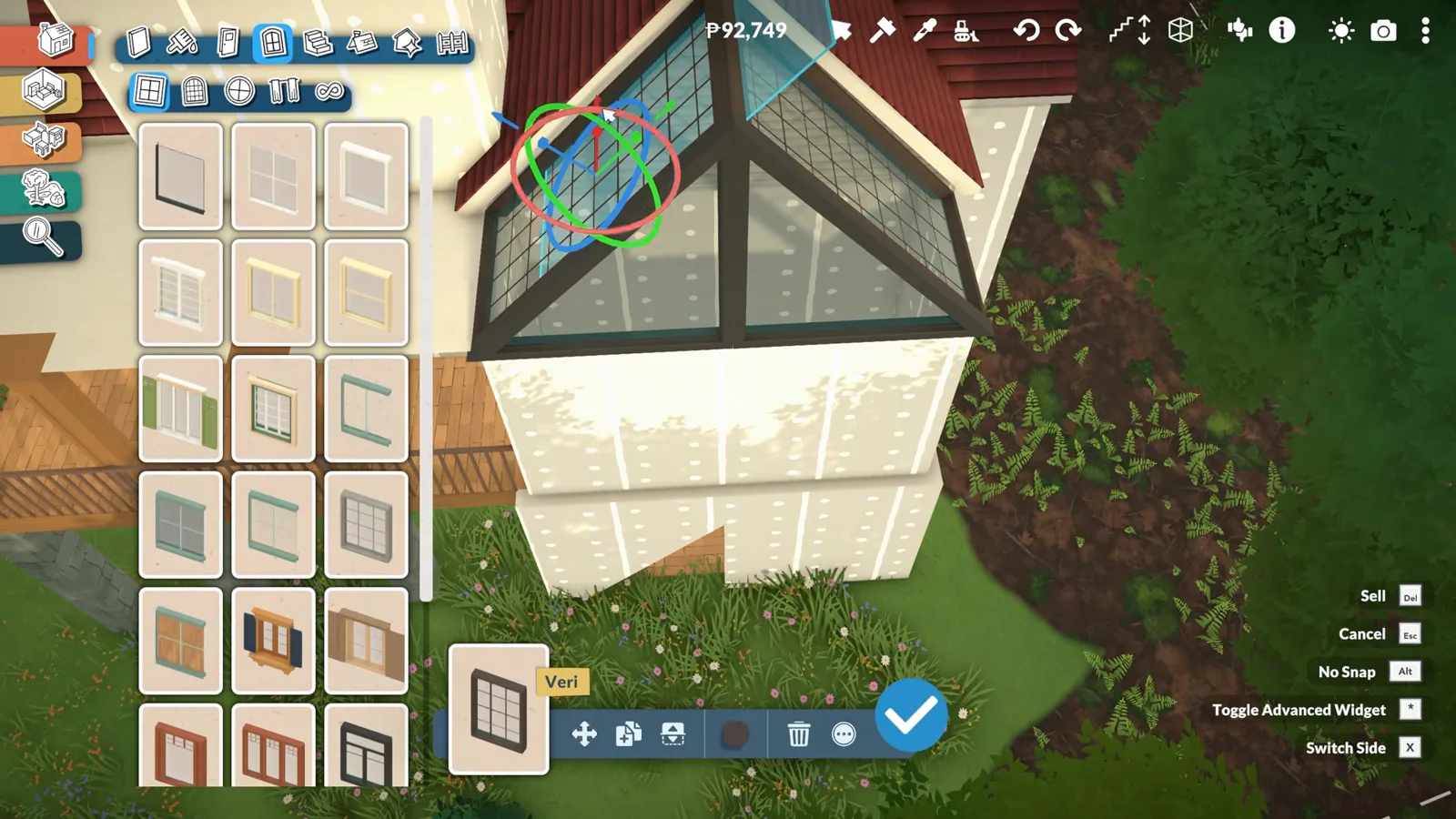
The sunroom's roof is its wall's window, tilted.Watch at 9:20 - 15
Search the catalogue for what goes inside
Inside the glass, the builder types planter into the catalogue search field and takes troughs and boxes from the results — searching is the fast route to a container when you know the word and not the category. Two dark troughs go on the herringbone floor under the glazing, and the potted flowers are dropped into them using the game's ability to raise and lower objects. The little bathroom visible at the edge of the frame makes the point: this wing is a room of the house, not a shed at the bottom of the garden.
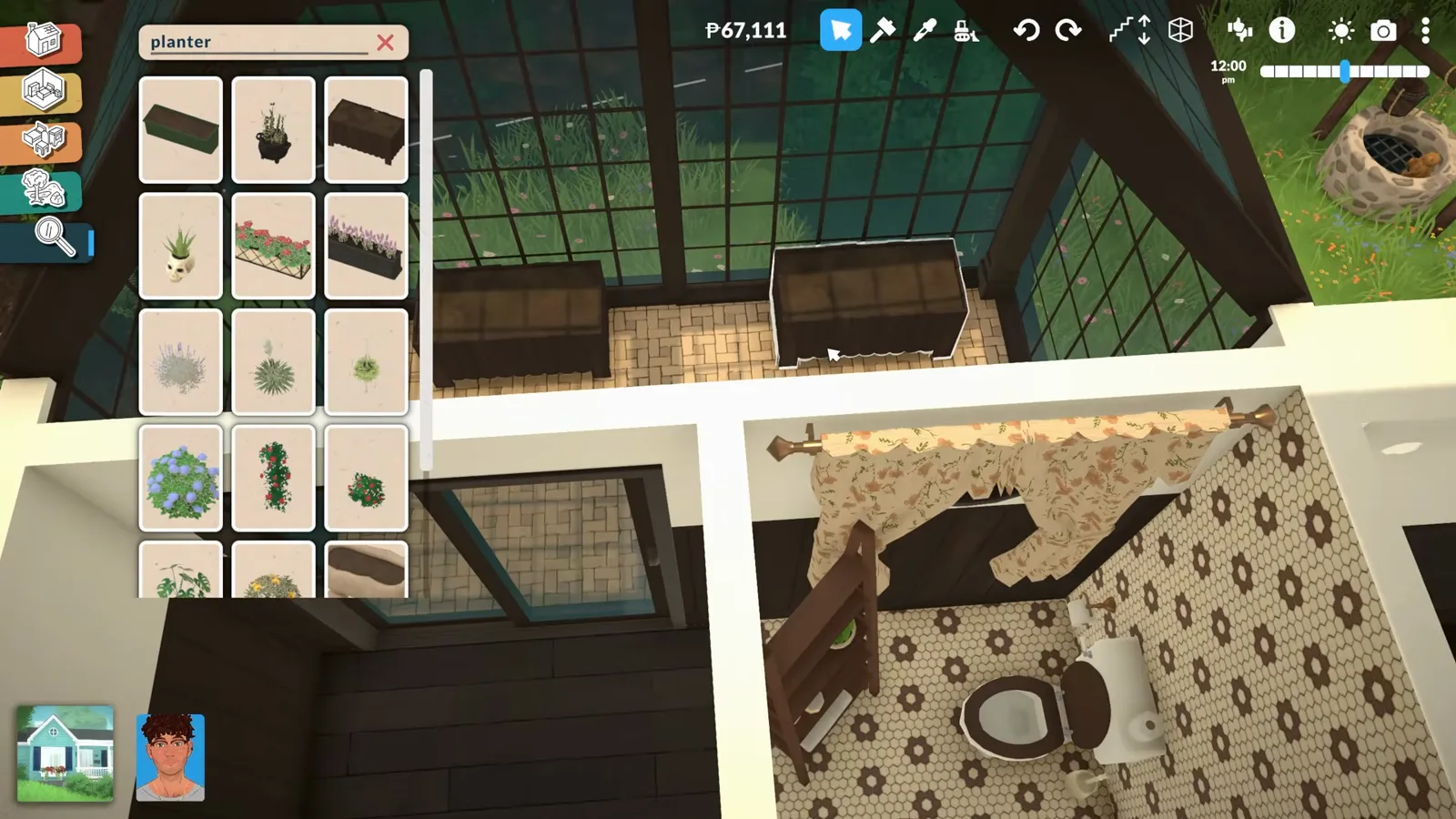
Type the word, skip the category tree.Watch at 33:20 - 16
Put the glass roof on last
The finished wing reads as a two-storey glass gable on a stone cottage: dark frames, planters and chairs visible through the panes, roof planes glazed down to the eaves. The builder says that final placement of the sunroom roof was effectively the last thing she did in a 47-minute build, because every earlier edit had taken it with her. Her second workaround is structural rather than cosmetic — the tower beside the wing had to grow from a square into a slight rectangle so its roof segments would fit around a room she still wanted to walk into.
Glazing that keeps vanishing goes on last — that is the lesson.Watch at 45:20
Paralives greenhouse FAQ
- Is there a greenhouse item in Paralives?
- No. Both builds on this page are assembled from the window catalogue: ordinary window pieces set side by side replace the walls, the same pieces rotated onto the pitch replace the roof, and the shaped tab's triangular and trapezoid panes close the gables. The cottagecore guide on this site reaches the same verdict from the other direction — there is no conservatory kit to buy, only a glass room to improvise.
- How do you make a glass roof in Paralives?
- Place flat window pieces where the roof should be and position them with the advanced widget, which lets a selected object move, tilt and rotate freely instead of snapping to a wall. Nothing centres them for you: the narrated builder on this page says the panes get lined up to the roof lines by eye, and in the first build the widget is still on the glass as each row goes in. The freestanding build above runs the glazing up both pitches and closes the ridge; the sunroom wing does the same thing at half the scale, with the wall and roof made of one window style.
- Why do my greenhouse windows keep disappearing?
- That is known Early Access behaviour of the advanced widget, and a glazed roof is the build most exposed to it. The studio has listed items losing their position on reload since patch 0.1.2; 0.1.7 made the tool much more reliable, but the issue is not closed. The narrated builder here reports a second trigger from her own session: changing a wall's height or thickness deleted the custom-placed glazing around it, repeatedly — which is why she left the glass roof until last.
- Do greenhouses do anything for plants in Paralives?
- Unverified. Neither video on this page, nor any source we have checked, documents a greenhouse mechanic — no temperature zone, no growth bonus for plants under glass, no season protection. Everything in this guide is architectural: the greenhouse is a room that looks and lights like one, and the plants inside it behave exactly as they would in a normal bedroom. If a later patch adds growing behaviour, this answer will need rewriting.
- Can you add a greenhouse to a house you already built?
- Yes — that is the second build here. The glazed wing was added to a hillside cottage as a room of the house, reached from the dining area through a sliding door, with trough planters inside and the main bedroom sitting directly underneath it on the floor below. Her one structural caveat: she reports that a roof does not cut away when a room is built around it, which is what forced the tower next to the wing to be reshaped. That observation comes from the game's first month of Early Access, and we have not re-tested it on 0.1.8b.
Keep building
Paralives roof tutorial
Shape every roofline and fix the ones that break — the tools a glazed pitch is built against, and the snapping this page's roof skips entirely.
Windows & doors guide
The catalogue tabs, styles and placement rules behind every pane on this page, from the Chani wall glazing to the shaped gable triangles.
Curved walls in Paralives
The other way to break a rectangular shell — arcs, and the windows they still refuse to take.
Related guides
Terrain tools guide
Paint the brick apron, sculpt the hillside a glass wing is set into, and plant the border that spills over the path.
Cottagecore house build
The same window-built greenhouse as one part of a whole preset-house transformation, with string lights and a potting table.
Ceilings & skylights
When glazing the roof is more trouble than it is worth: ceilings, skylights and the missing-ceiling fix.
Move objects & free placement
The advanced widget behind every tilted pane here — and the reason some of them wander off after a reload.
Decks, patios & balconies
Hardstanding and outdoor rooms for the approach, if painted brick is not enough underfoot.
Paralives house ideas
Footprints and concepts to steal from — including where a glazed wing earns its keep on a lot.